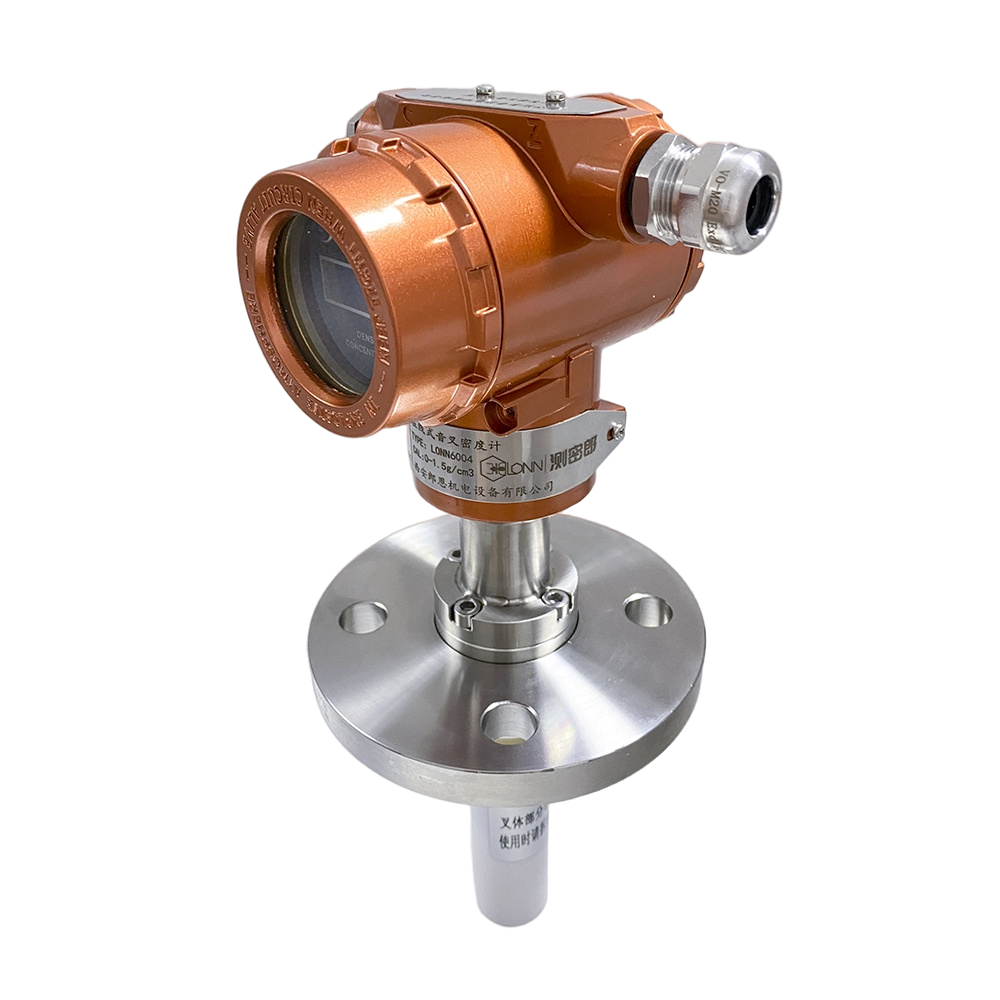
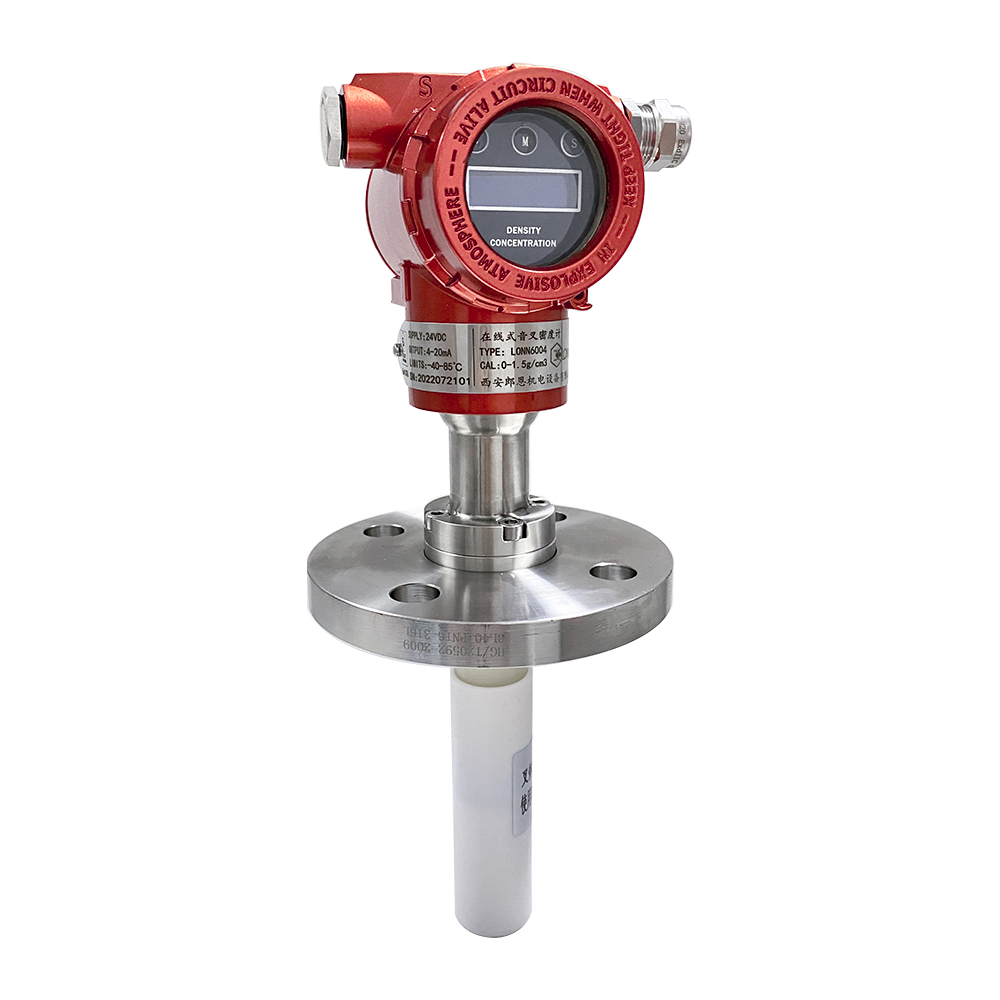
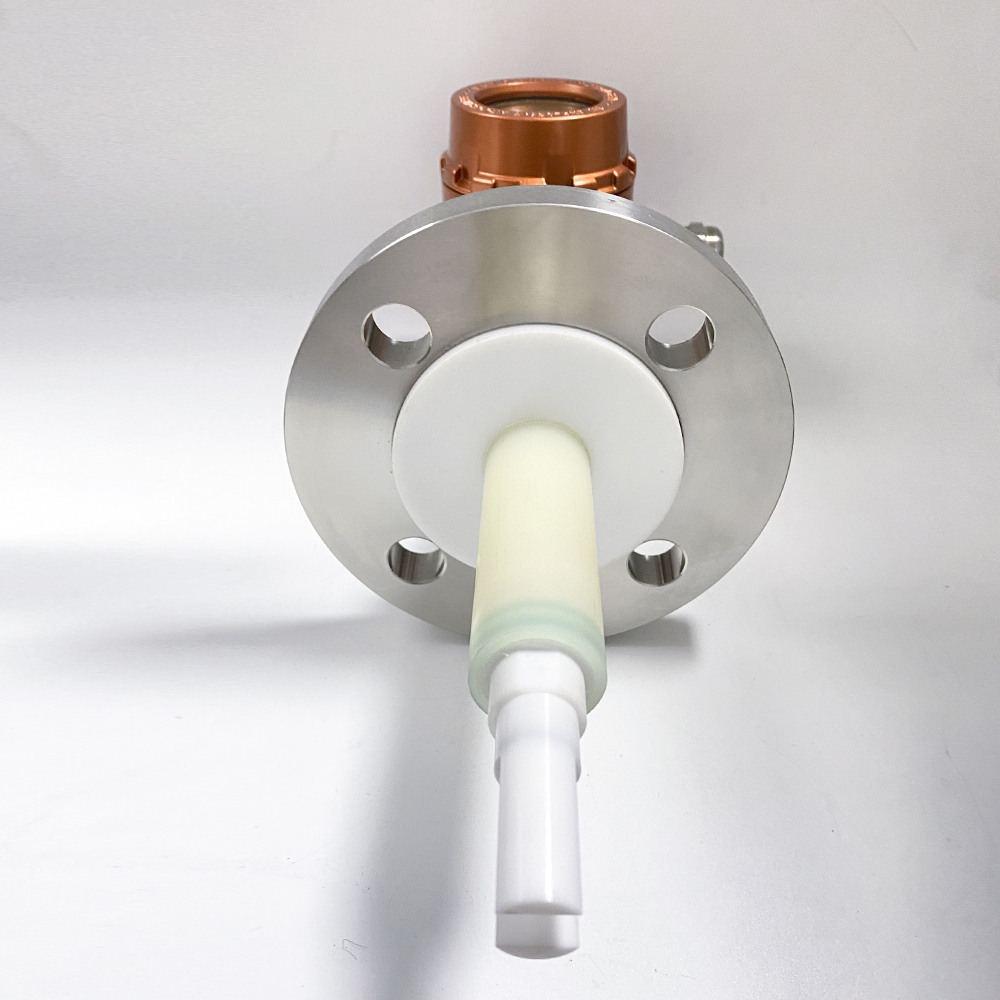
LONN-700C ceramic tuning fork density meter: ±0.002 g/cm³ accuracy in abrasive slurry.
Ceramic fork tines (1200+ HV) resist sand/mineral erosion.
Non-nuclear design eliminates radioactive licensing.
4-20mA + RS485; ANSI/DIN/JIS flange or tri-clamp.
LONNMETER serves 130+ countries.
When standard polished stainless steel or PTFE-coated tuning fork density sensors fail prematurely in abrasive slurry service — pitting, grooving, and erosion of the fork tines within weeks of installation — the LONN-700C ceramic tuning fork density meter changes the equation entirely. Unlike conventional tuning fork density meters where the fork tines are bare 316L stainless steel or coated with soft polymer, the LONN-700C features fork tines made from ceramic material — a hard, dense oxide ceramic with Vickers hardness exceeding 1200 HV, roughly six times harder than 316L stainless steel. In mining slurry pipelines, sand and gravel processing circuits, mineral concentrate launders, and dredging transfer lines, the LONN-700C keeps measuring accurately where other instruments surrender to erosion.
The ceramic tuning fork density meter operates on the same proven vibration frequency principle as the standard LONN-700CM — a pair of fork prongs vibrate at their natural resonant frequency, which shifts in direct proportion to the density of the surrounding liquid. The ceramic fork tines add zero interference to the acoustic signal: the fork still vibrates freely, the frequency still responds precisely to fluid density changes, and the measurement still achieves ±0.002 g/cm³ accuracy across the full 0~2 g/cm³ range. What changes is the service life — measured not in months but in years, even in the most aggressive sand-laden and mineral-laden slurry streams found in hard rock mining, coal preparation, and offshore dredging operations.
This ceramic fork density meter is available with 316L stainless steel, Hastelloy C-276, Titanium, or Zirconium wetted materials for the sensor body and process connection, each paired with ceramic fork tines for the actively vibrating element. The result is an inline density measurement solution that survives where competitive instruments require constant replacement — reducing unplanned downtime, eliminating measurement gaps during critical concentration control loops, and delivering a genuine total cost of ownership advantage that more than justifies the modest premium over standard configurations.
Any slurry pipeline carrying solid particles — whether iron ore concentrate, copper tailings, coal slurry, sand-water mixtures, or mineral precipitate — subjects instrument sensor surfaces to continuous particle impact. Particles suspended in turbulent flow strike exposed surfaces at velocities determined by flow regime, particle specific gravity, and pipeline geometry. Over time, this solid-particle erosion removes material from sensor surfaces, fundamentally altering their geometry and destroying measurement accuracy.
Standard polished 316L stainless steel fork tines in most tuning fork density sensors begin showing measurable erosion marks within 2-4 weeks in typical mining slurry service. By three months, fork tine geometry has shifted enough to invalidate factory calibration. PTFE-coated forks — while excellent for sticky media like polymer solutions or adhesive chemical slurries — wear through the polymer layer even faster in abrasive service, exposing the bare metal beneath and defeating the purpose of the coating entirely.
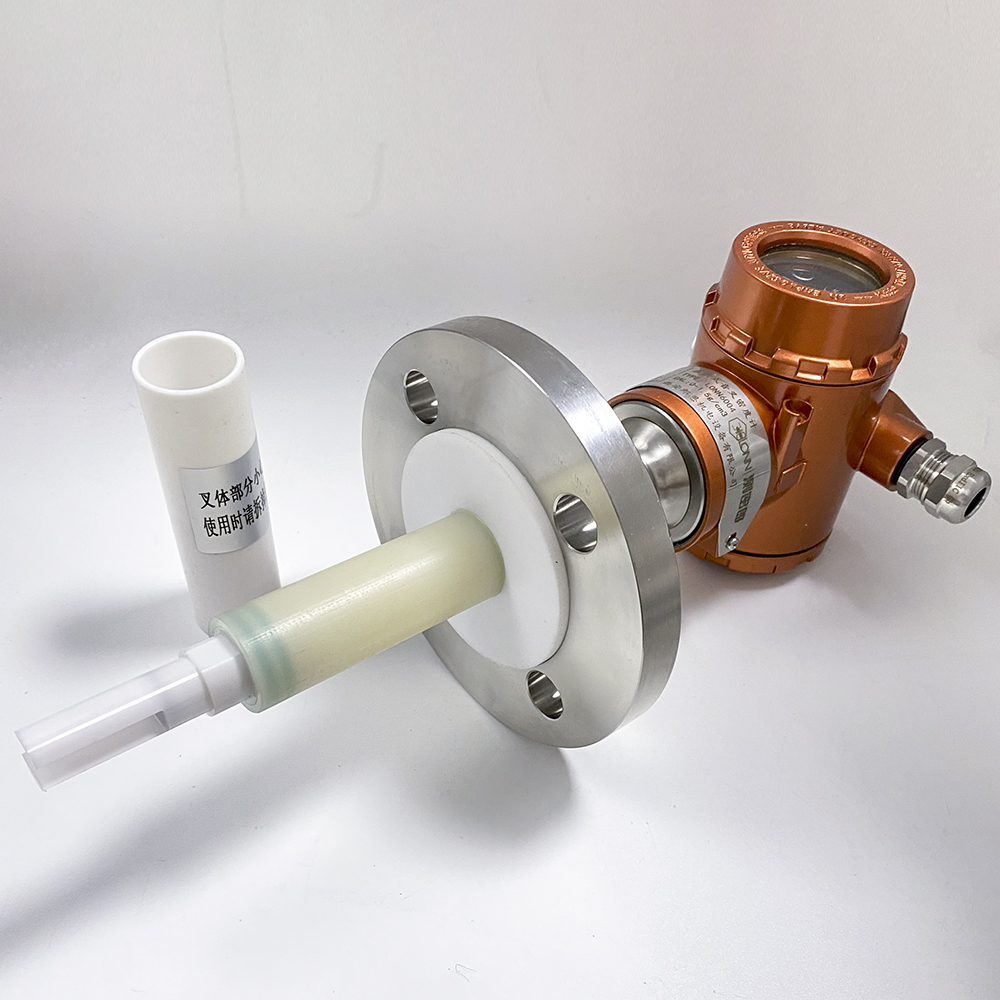
The LONN-700C addresses this failure mode at its root. The fork tines themselves are made from ceramic material — a hard, dense, inert oxide ceramic with Vickers hardness exceeding 1200 HV, roughly six times harder than 316L stainless steel (~200 HV) and significantly harder than PTFE polymer (~100 Shore D). This extreme hardness means mineral particles in the slurry — quartz, feldspar, magnetite, pyrite, and other silicates and sulfides common in mining streams — simply cannot penetrate or scratch the ceramic surface at normal pipeline flow velocities.
The characteristic orange color of the ceramic fork tines reflects the specific iron-oxide-based ceramic formulation (equivalent to alumina-toughened zirconia or similar oxide ceramic systems) that provides the optimal balance of hardness, fracture toughness, thermal expansion matching to the stainless steel substrate, and long-term adhesion under cyclic vibration loading. The ceramic tines are manufactured using a thermal spray process that creates a metallurgically bonded, dense, uniform ceramic layer typically 150-300 microns thick — enough to provide years of erosion protection even in high-velocity slurry pipelines.
| Treatment | Hardness (HV) | Abrasion Resistance | Chemical Resistance | Temperature Limit | Best Service |
|---|---|---|---|---|---|
| 316L Polished | ~200 HV | Poor — rapid erosion | Excellent | +200°C | Clean liquids only |
| PTFE Coating | ~100 Shore D | Poor — tears in slurry | Excellent (pH 1-14) | +150°C | Sticky/polymer media |
| Hard Chrome | ~800 HV | Good initially | Fair — pitting in acid | +200°C | Moderate slurry |
| Ceramic Fork Tines | ~1200 HV | Excellent — superior | Excellent (inert) | +200°C | Abrasive slurry, mining, dredging |
| Parameter | Specification |
|---|---|
| Measurement Principle | Tuning fork vibration frequency (oscillating fork, no radioactive source) |
| Fork Tine Material | Ceramic (oxide ceramic, 1200+ HV hardness, 150-300μm thickness on vibrating tines) |
| Sensor Body Material | 316L Stainless Steel / Hastelloy C-276 / Titanium Grade 2 / Zirconium 702 (select from options) |
| Density Range | 0 ~ 2 g/cm³ (0 ~ 2000 kg/m³) |
| Density Accuracy | ±0.002 g/cm³ |
| Density Repeatability | ±0.0001 g/cm³ |
| Concentration Range | 0 ~ 100% (user-defined calibration curves) |
| Concentration Accuracy | ±0.25% (after multi-point calibration) |
| Temperature Coefficient | 20 ppm/°C (automatic temperature compensation to 20°C reference) |
| Process Temperature | Standard: -25°C ~ +120°C; Extended high temperature: -25°C ~ +150°C |
| Max Working Pressure | Standard: 2.5 MPa; High pressure (special order): 6.3 MPa |
| Output Signals | Primary: 4-20mA (density, loop-powered, 250Ω max load) Secondary: 4-20mA (temperature) Digital: RS485 Modbus RTU (9600/19200/38400 baud) |
| Power Supply | 24V DC (±10%), two-wire loop-powered configuration |
| Display | Backlit LCD, 4-line × 20-character, full Chinese/English menu |
| Transmitter Enclosure | IP65 die-cast aluminum, epoxy powder coating |
| Process Connection | Flange: ANSI 150#/300#/600# / DIN PN16/PN40/PN64 / JIS 10K/20K; Sanitary: Tri-clamp 2″/3″ |
| Max Medium Viscosity | 2000 cP |
| Particle Size Limit | <10μm recommended; 10-50μm acceptable with reduced accuracy |
| Max Suspended Solids | ≤40% by volume |
| Max Gas Content | ≤20% by volume |
| Data Storage | 20,000 real-time records + 400 records/day automatic logging |
| Remote Data | 4G DTU module available (custom order, cloud/PC/mobile monitoring) |
| Hazardous Area | ATEX/IECEx Zone 1 explosion proof version available (specify when ordering) |
| Certifications | CE, FCC, ISO9001, ATEX, IECEx |
The LONN-700C ceramic tuning fork density meter is engineered for continuous liquid density measurement in particle-laden process streams. The vibrating fork measures the density of the continuous liquid phase plus the contribution of suspended solids — provided the particles remain in suspension and do not settle between the fork tines. Understanding the relationship between particle characteristics and measurement quality is essential for optimal instrument selection.
For particles below 10μm in diameter — fine mineral suspensions such as flotation concentrates, colloidal silica, and sub-sieve process streams — the particles behave essentially as part of the fluid medium and do not introduce significant measurement noise. The tuning fork vibrates through the suspension uniformly, and the density reading accurately represents the total mass per unit volume of the fluid-particle mixture.
For particles between 10μm and 50μm — typical of hydrocyclone overflow, classifier overflow, and conventional flotation tailings streams — some measurement noise appears due to intermittent particle impingement on the fork surfaces. The ceramic fork tines absorb this impact without damage or geometry change, ensuring that measurement drift does not occur even as particles continuously strike the tines. The ceramic surface maintains its smooth, precisely calibrated geometry indefinitely, unlike unprotected metal surfaces that erode progressively.
For particles above 50μm — coarse sand, gravel, or grinding circuit product — the LONN-700C is not recommended. Large particles can become lodged between fork tines or generate impact forces sufficient to crack even ceramic surfaces at very high velocities. For coarse particle slurry service, the LONN-7000 ultrasonic slurry density meter using acoustic impedance technology is the recommended alternative.
In standardized erosion testing using 30μm silica sand slurry at 3 m/s flow velocity over 1,000 operating hours:
| Fork Surface | Weight Loss | Tine Geometry Change | Calibration Drift | Remaining Life After Test |
|---|---|---|---|---|
| 316L Polished | 2.4 g | Significant — measurable wear groove | +0.015 g/cm³ | Failed at 200h |
| PTFE Coated | Coating worn through at 150h | Exposed metal beneath | +0.008 g/cm³ | Failed at 400h |
| Ceramic Fork Tines | <0.02 g | Zero measurable change | <0.0002 g/cm³ | >1000h, still measuring |
The ceramic fork tines demonstrated essentially no measurable wear or accuracy degradation over the full 1,000-hour test — confirming their suitability for multi-year continuous service in abrasive slurry pipelines without recalibration or replacement.
Hard rock mining operations — copper, gold, iron ore, nickel, lead, zinc, and polymetallic sulfide ores — generate enormous volumes of slurry at every stage of the process: grinding circuit classification, flotation concentration, tailings disposal, and concentrate dewatering. Pipeline densities in these circuits typically range from 1.05 to 1.60 g/cm³, and accurate density measurement is critical for:
Offshore and river dredging operations move enormous quantities of sand, gravel, and sediment slurries through floating pipeline systems. The LONN-700C ceramic tuning fork density meter provides:
Construction aggregate washing and classification plants process sand, gravel, and crushed rock into sized products for concrete, asphalt, and construction fill. The LONN-700C ceramic fork density meter monitors:
Chemical processes involving catalyst slurries, mineral acid slurries, lime slurry, gypsum slurry, and other solid-laden chemical streams benefit from the ceramic fork’s combined chemical and abrasion resistance:
The single most important factor in achieving stable, accurate, long-term density measurement is correct instrument location in the pipeline. Follow these placement guidelines for slurry service:
| Feature | LONN-700C (Ceramic Fork) | LONN-700CM (Standard/PTFE) | LONN-7000 (Ultrasonic) |
|---|---|---|---|
| Measurement Principle | Tuning fork vibration | Tuning fork vibration | Ultrasonic acoustic impedance |
| Primary Advantage | Superior fork tine abrasion resistance | Chemical resistance, sticky media | No obstruction in flow path |
| Fork Tine Material | Ceramic (1200+ HV) | Polished 316L or PTFE | N/A — no fork in flow |
| Max Particle Size | 50μm | 50μm | 500μm (large particles OK) |
| Max Solids Concentration | 40% | 40% | 70%+ |
| Density Accuracy | ±0.002 g/cm³ | ±0.002 g/cm³ | ±0.005 g/cm³ |
| Min. Flow Velocity Required | >0.5 m/s | >0.5 m/s | No minimum (static OK) |
| Best Slurry Type | Abrasive mineral, sand, ore | Clean to moderate solids | Heavy mining slurry, tailings, thickener underflow |
| Typical Applications | Mining grinding/classification, sand washing, dredge discharge | Chemical process, pharmaceutical, food, general industrial | Heavy mining slurry, classifier overflow, tailings pipeline |
| Fork Tine Erosion Risk | None — ceramic protected | High in abrasive slurry | N/A |
Selection Rule:
Q: Do the ceramic fork tines affect the tuning fork vibration frequency or measurement accuracy?
A: No. The ceramic fork tines are manufactured with precise geometry accounted for during factory calibration. The LONN-700C achieves identical ±0.002 g/cm³ accuracy as the standard LONN-700CM with polished metal fork. Third-party laboratory verification using certified reference density liquids (water, glycerol solutions, and calcium chloride solutions) confirms measurement uncertainty well within specification across the full 0~2 g/cm³ range.
Q: How long do the ceramic fork tines last before they need replacement?
A: The ceramic fork tines are designed for the operational lifetime of the instrument — typically 8-15 years under normal slurry service conditions. Unlike PTFE coatings that can tear or delaminate, the ceramic material is metallurgically bonded to the fork substrate and cannot peel off during normal operation. The ceramic hardness exceeds that of common slurry particles (quartz ~700 HV, magnetite ~600 HV, pyrite ~1000 HV) — under normal pipeline velocities, particle impact does not remove ceramic material at a measurable rate. The only scenario that would damage the ceramic tines is severe cavitation or direct impact by a large foreign object — which would damage any sensor surface.
Q: Can I use the LONN-700C in seawater or chloride-containing slurry?
A: Yes — select the Hastelloy C-276 or Titanium Grade 2 sensor body material for seawater or chloride slurry applications. Both Hastelloy and Titanium provide excellent chloride stress corrosion cracking resistance. The ceramic fork tines themselves are chemically inert to seawater and chloride solutions. Standard 316L stainless steel sensor body is suitable for seawater applications below +30°C, but for elevated temperature seawater or concentrated chloride brines, specify Hastelloy or Titanium wetted material.
Q: What is the minimum flow velocity required to prevent particle settling around the fork tines?
A: The LONN-700C requires minimum slurry flow velocity of 0.5 m/s at the instrument location to ensure particles remain in suspension and do not accumulate on or between the fork tines. For static or very low-velocity process conditions, particle settling between the fork tines can create a protective particle layer that biases the density reading high. If your application cannot guarantee 0.5 m/s minimum velocity, consider the LONN-7000 ultrasonic density meter, which has no obstruction in the flow path and is unaffected by particle settling.
Q: How does the LONN-700C compare to nuclear/radiometric density gauges used in mining?
A: The LONN-700C delivers comparable or superior accuracy (±0.002 g/cm³) compared to nuclear density gauges (±0.005~0.01 g/cm³ depending on geometry) while eliminating every radioactive source management requirement: no source import/export licenses, no annual radiation safety inspections, no sealed source leak testing, no emergency response planning, no specialized transport documentation, and no decommissioning cost for radioactive material disposal. For sites operating radiometric gauges, the LONN-700C provides a clear path to source removal — particularly relevant as radioactive source security regulations tighten globally and disposal costs escalate.
Q: Is field calibration required after installation, and how is it performed?
A: The LONN-700C arrives factory-calibrated using certified reference density standards traceable to national measurement institutes. For most applications, no field calibration is required — install the instrument, enter the process fluid calibration parameters (slope and intercept for your specific liquid), and begin measuring. For custody transfer or regulatory measurement applications requiring ISO/IEC 17025 traceable calibration certificates, LONNMETER provides factory calibration services with certified reference liquid measurements. Field calibration is performed by entering known-density reference samples (provided calibration kit) through the LCD menu — the two-point calibration corrects for any minor offset between factory calibration and specific installation conditions.
Q: What maintenance does the ceramic fork density sensor require?
A: Minimal maintenance. The ceramic fork tines do not corrode, pit, erode, or delaminate under normal operating conditions. The only regular maintenance task is periodic cleaning of any accumulated deposits on the fork tines — use clean process liquid or water flush only. Never use hard tools, brushes, or scrapers on the ceramic surfaces. Inspect the process connection flange gasket periodically for leakage and replace if compressed set is observed. For remote transmitter versions, verify cable connector sealing and tighten if any moisture ingress is suspected. Annual verification against a reference density measurement (portable density meter or lab sample) is recommended for quality assurance programs.
Configure your LONN-700C ceramic tuning fork density meter: Email anna@xalonn.com or complete our RFQ form. Please include:
What you receive with every quote: Full technical datasheet, dimensional drawing (PDF), Modbus register map, installation manual, and application engineering review — at no charge. LONNMETER’s application team reviews every inquiry to confirm instrument suitability for your specific process conditions before proposing a solution.
As a direct-from-manufacturer density measurement specialist, LONNMETER supplies the ceramic tuning fork density meter with factory pricing, global technical support .
Please provide your application parameters for a technical assessment and formal quote.