
The LONN-GMFC thermal mass flow meter represents a breakthrough in gas flow measurement technology. Unlike traditional volumetric flow meters that require separate temperature and pressure compensation to calculate mass flow, this mass flow meter for gas measures mass flow directly using thermal principles.
The thermal mass flow meter operates on the constant temperature difference method:
This thermal gas flow meter technology ensures accurate measurement across varying process conditions without additional compensation calculations.
| Parameter | Specification |
|---|---|
| Measurement Range | 0.5 – 100 Nm/s velocity |
| Turndown Ratio | 100:1 typical |
| Accuracy | ±1.5% – 2.5% of reading |
| Repeatability | ±0.5% |
| Response Time | 1 second standard (adjustable) |
| Temperature Drift | <0.05%/°C |
| Pressure Effect | Negligible (mass flow directly measured) |
| Component | Standard Range | High Temperature Option |
|---|---|---|
| Sensor | -40°C to +200°C | -40°C to +450°C |
| Transmitter/Converter | -20°C to +60°C | -20°C to +60°C |
| Ambient (Display) | -20°C to +60°C | -20°C to +60°C |
| Installation Type | Maximum Pressure |
|---|---|
| Inline (Flanged) | <4.0 MPa |
| Insertion (Wet-tap) | <2.5 MPa |
| Output Type | Details |
|---|---|
| Analog | 4-20mA, 2-wire or 4-wire, isolated |
| Digital | RS-485 Modbus RTU, baud rate 9600-115200 |
| HART | HART 7 protocol over 4-20mA |
| Fieldbus | Foundation Fieldbus (FF) optional |
| Pulse | Open collector, configurable scaling |
| Power Consumption | <20W |
| Feature | Specification |
|---|---|
| Display | 4-line Chinese/English LCD |
| Display Content | Flow rate, total flow, standard volume, accumulated time |
| Enclosure Material | Die-cast aluminum (explosion-proof) |
| Probe Material | 316L stainless steel |
| Sheath Options | 316L, Hastelloy C, Ceramic |
| Process Connection | Flange (inline), Ball valve assembly (insertion) |
| Ingress Protection | IP67 (integral), IP68 (remote sensor) |
Application: DN65 to DN1000 pipe sizes
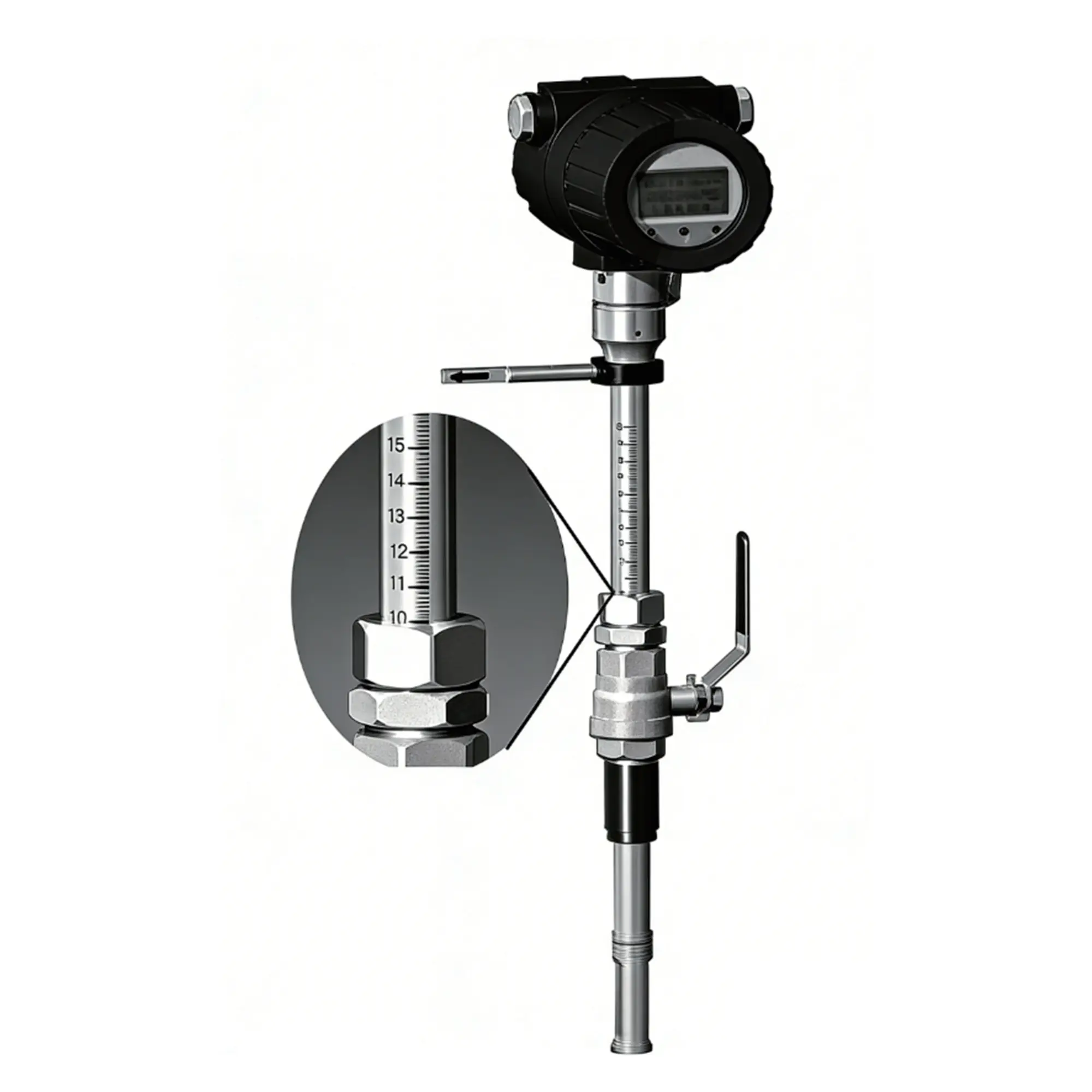
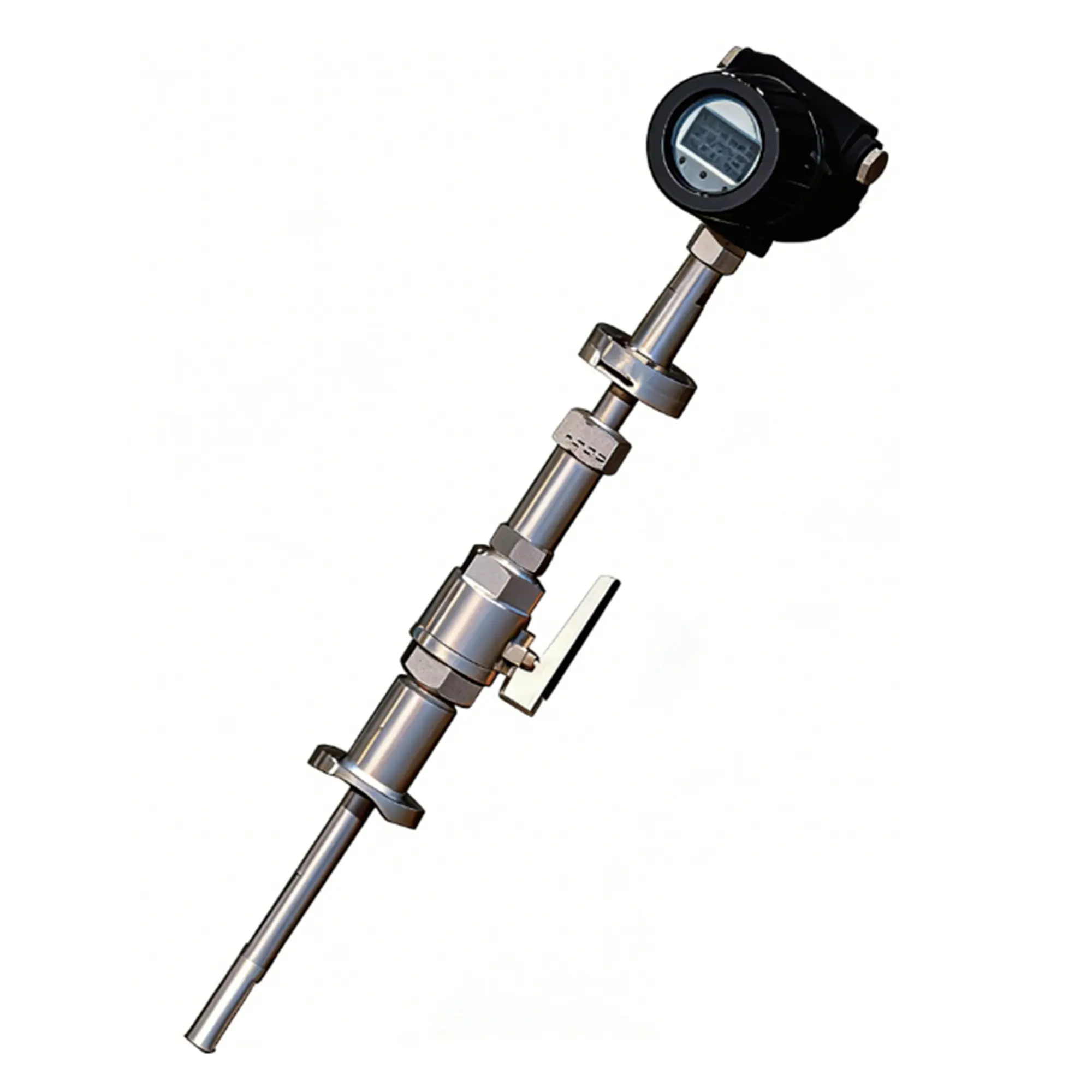
The insertion thermal flow meter design features a retractable probe assembly with ball valve installation, enabling hot-tap installation without process shutdown. The depth scale (10-15 markings visible on probe) ensures accurate centerline positioning for optimal measurement accuracy.
Key Features:
Application: DN15 to DN80 pipe sizes
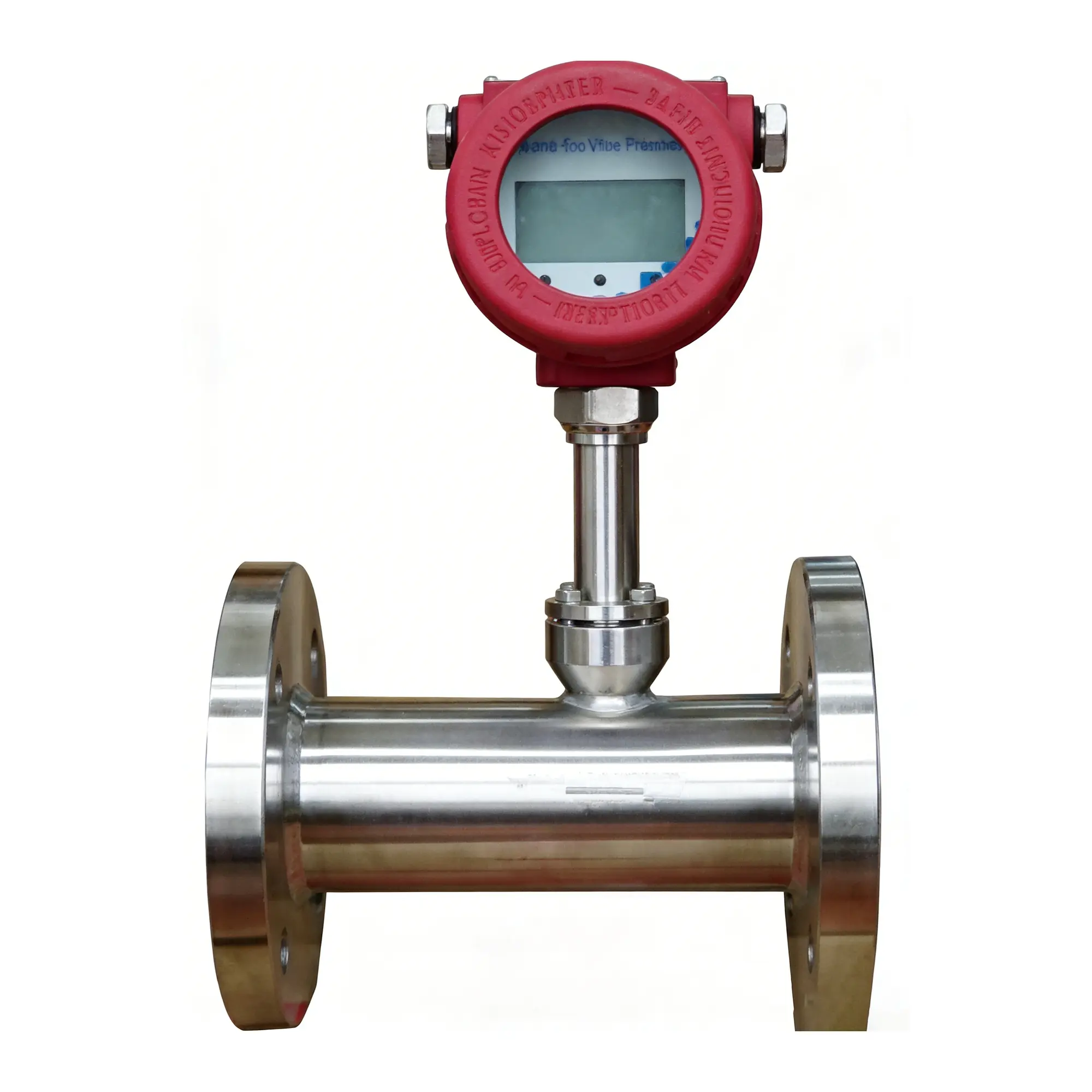
The inline thermal mass flow meter configuration provides a complete flanged meter body with integral flow conditioning. This design ensures optimal sensor positioning and eliminates installation sensitivity.
Key Features:
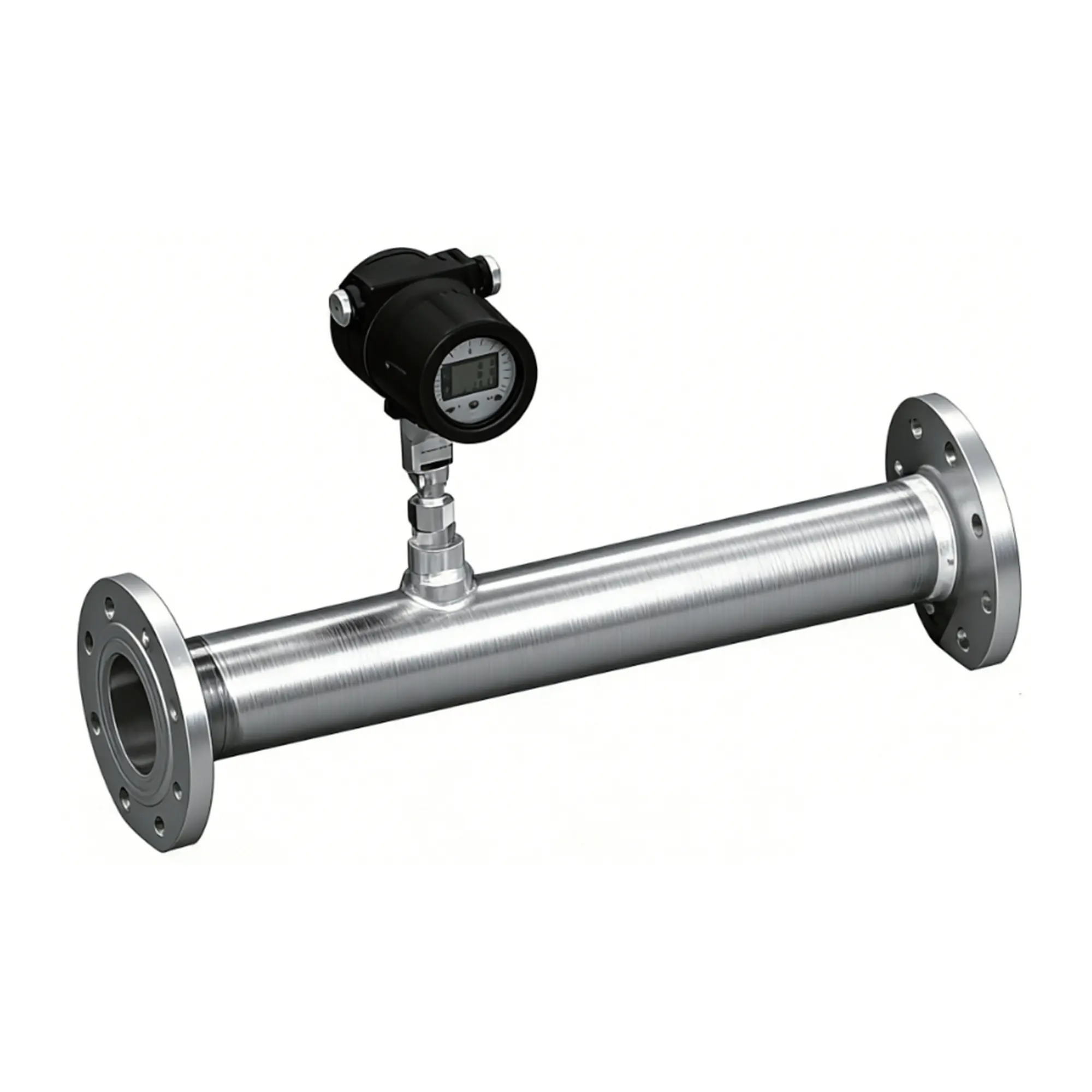
Application: DN100 to DN4000 pipe sizes
For medium to large pipe applications, this inline thermal mass flow meter variant provides robust construction with heavy-duty flanges and extended sensor probes to ensure representative flow measurement across the full pipe diameter.
The thermal mass flow meter measures mass flow directly, eliminating the need for separate temperature and pressure compensation. This simplifies installation, reduces system cost, and improves measurement accuracy across varying process conditions.
With a 100:1 turndown ratio and velocity range from 0.5 to 100 Nm/s, this thermal gas flow meter handles everything from low-flow leak detection to high-volume process measurements with a single device.
The solid-state sensor design has no moving parts and no pressure sensing elements, ensuring exceptional reliability and long service life even in demanding industrial environments.
The mass flow meter for gas measures virtually any gas or gas mixture (except acetylene), including:
The insertion design allows installation and maintenance without process shutdown where conditions permit. The digital electronics and modular construction simplify field service and reduce downtime.
Standard RS-485 Modbus RTU and optional HART/FF protocols enable seamless integration with DCS, PLC, and SCADA systems for industrial automation and process control applications.
Monitor compressor efficiency, detect leaks, and allocate costs with accurate thermal mass flow meter measurements that require no pressure compensation across varying system pressures.
Custody transfer and process measurement applications benefit from direct mass flow measurement that remains accurate despite temperature and pressure variations in the distribution network.
Measure biogas production from anaerobic digesters and landfill gas recovery systems. The thermal gas flow meter handles varying gas compositions and moisture content common in these applications.
Process gas measurement, reactor feed monitoring, and vent gas flow measurement in chemical plants and refineries.
Carbon dioxide flow measurement for carbonation, nitrogen blanketing flow monitoring, and compressed air system optimization.
Stack gas flow measurement, flare gas monitoring, and emissions measurement applications.
⚠️ Important Installation Notes:
A thermal mass flow meter measures gas mass flow rate by detecting the cooling effect of gas flow on a heated sensor. As gas flows past the heated element, it carries away heat proportional to the mass flow rate. The electronics maintain a constant temperature difference and measure the electrical power required, which directly correlates to mass flow.
Thermal mass flow meters offer several advantages:
The thermal gas flow meter measures virtually any clean, dry gas including air, nitrogen, oxygen, natural gas, biogas, argon, hydrogen, and process gases. Acetylene is the primary exclusion due to safety considerations.
The thermal mass flow meter uses constant temperature difference technology that automatically compensates for gas temperature variations. The sensor pair includes a reference temperature sensor and a heated sensor, maintaining accuracy across the specified temperature range.
Standard outputs include 4-20mA analog, RS-485 Modbus RTU, and pulse. Optional HART and Foundation Fieldbus protocols are available for advanced control system integration.
Contact our technical sales team for pricing and configuration assistance:
Fill out our RFQ form  Email: anna@xalonn.com
  Phone: +86-180-9211-4467
  Website: www.smartmeasurer.com
Please provide the following information for a detailed quotation:
Application Details:
Product Configuration:
Output Requirements:
Additional Requirements:
LONNMETER — Precision Flow Measurement Solutions for Industrial Applications