When your process requires precise density measurement — whether for concentration control, quality verification, or custody transfer — you face a fundamental choice between two technologies: the inline density meter (using tuning fork, ultrasonic, or microwave principles) and the Coriolis mass flow meter with density output.
Both instruments measure density. This inline density vs coriolis comparison explains how each technology works and which delivers better results for your specific process conditions. Both can be installed in-line. Both can provide 4-20mA or digital outputs for process control. So how do you choose?
This guide provides a systematic comparison across accuracy, installation complexity, cost, maintenance, and application suitability — with a frank assessment of where each technology excels and where it falls short.
1. Inline Density Meter vs Coriolis: Measurement Principles
Inline Density vs Coriolis — Technology Comparison
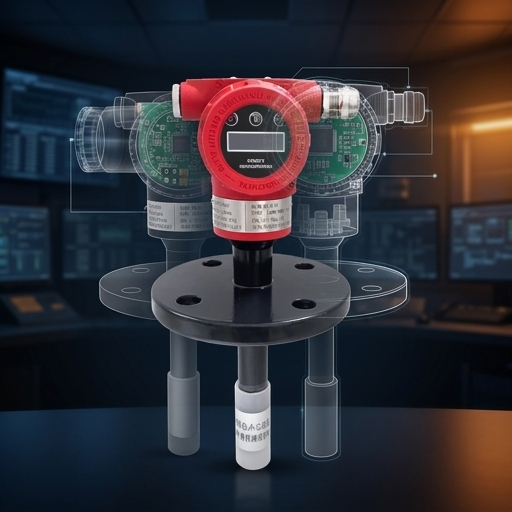
Inline Density Meter
An inline density meter measures density by detecting a physical property of the process fluid that varies with density:
- Tuning fork / oscillating U-tube: The vibrating element’s resonance frequency changes with fluid density (added mass effect)
- Ultrasonic / acoustic impedance: Ultrasonic pulse reflection at the sensor-fluid interface varies with fluid acoustic impedance (a function of density and sound speed)
- Microwave: Microwave signal attenuation varies with fluid density and composition
All inline density meters share a common characteristic: they are dedicated density instruments — their sole output is a density (or concentration) signal. They typically do not measure flow rate.
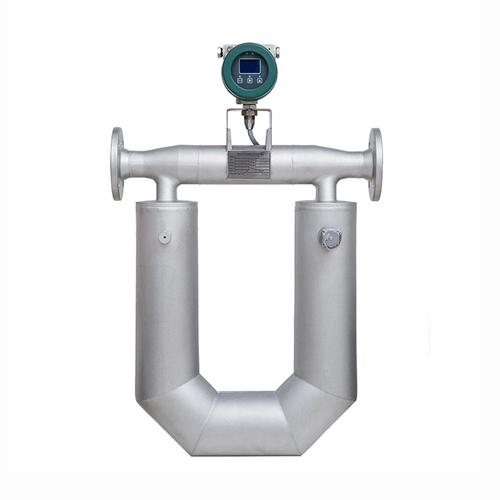
Coriolis Mass Flow Meter
A Coriolis mass flow meter works on a different principle entirely. Two curved tubes are vibrated at their resonance frequency. As fluid flows through the tubes, the Coriolis effect causes a phase shift between the inlet and outlet of each tube — and this phase shift is directly proportional to mass flow rate.
The crucial secondary capability: because the tubes vibrate at their resonance frequency (determined by the mass of the tube plus the mass of the fluid inside), the resonance frequency itself is a direct measure of fluid density — independent of flow rate. A Coriolis meter therefore outputs both mass flow rate AND density from a single instrument.
2. Accuracy Comparison
| Parameter | Inline Density Meter | Coriolis Mass Flow Meter |
|---|---|---|
| Density accuracy | ±0.001 to ±0.005 g/cm³ | ±0.0001 to ±0.0005 g/cm³ |
| Density repeatability | ±0.0005 g/cm³ | ±0.00005 g/cm³ |
| Mass flow accuracy | Not measured | ±0.1 to ±0.5% of reading |
| Zero stability | Excellent | Excellent |
| Span stability | Good | Excellent |
Verdict: Coriolis wins on absolute accuracy. A precision Coriolis meter achieves density accuracy roughly 10× better than the best inline density meter. For custody transfer, pharmaceutical certification, or high-value product applications where ±0.0005 g/cm³ matters, Coriolis is the clear choice.
For routine process control — maintaining acid concentration within ±0.01 g/cm³, monitoring slurry density to ±0.005 g/cm³ — a well-selected inline density meter delivers more than sufficient accuracy at a fraction of the cost.
3. Cost Comparison
| Cost Element | Inline Density Meter | Coriolis Mass Flow Meter |
|---|---|---|
| Instrument cost (DN25) | $800-2,500 | $3,500-8,000 |
| Installation cost | $200-800 | $400-1,500 |
| Integration cost | $200-600 | $400-1,200 |
| Calibration cost (annual) | $150-400 | $400-1,000 |
| 5-year total cost of ownership | $2,500-6,500 | $9,000-20,000 |
Verdict: Inline density meters cost 3-5× less than Coriolis meters for equivalent density measurement capability. The cost differential is significant enough that in most process control applications — where ±0.001-0.005 g/cm³ accuracy is sufficient — the economic case for inline density measurement is compelling.
Where Coriolis cost is justified: custody transfer applications, high-value product lines (pharmaceutical, specialty chemicals), or situations where both mass flow and density must be measured simultaneously.
4. Installation Comparison
Inline Density Meter
Inline density meters are installed directly in the process pipe or in a by-pass loop. The installation requirements depend on the specific technology:
Tuning fork meters:
- Requires DN25 or larger process connection
- Flow direction matters (typically horizontal installation preferred)
- Some models require specific upstream/downstream straight-run conditions
- Can often be installed in by-pass loop to avoid process shutdown
Ultrasonic meters:
- Clamp-on options available (no process interruption)
- By-pass installation also common
- Requires accessible pipe section for transducer mounting
Typical installation time: 2-4 hours per point
Coriolis Mass Flow Meter
Coriolis meters have specific installation requirements that can significantly increase installation complexity and cost:
- Upstream straight run: 5-10 diameters recommended
- Downstream straight run: 3-5 diameters recommended
- Orientation: Must be installed in a position that keeps the measuring tubes full of liquid (no gas pockets)
- Process shutdown required: In-line installation typically requires cutting the pipe and welding flanges
- Alignment: Sensors must be oriented correctly relative to flow direction
Typical installation time: 4-8 hours per point (significantly higher than inline density meters)
Verdict: Inline density meters are significantly easier and cheaper to install — particularly the clamp-on and by-pass configurations. For retrofit applications where process shutdown is costly or impractical, inline density measurement is the practical choice.
5. Maintenance Comparison
| Maintenance Aspect | Inline Density Meter | Coriolis Mass Flow Meter |
|---|---|---|
| Scheduled maintenance | Minimal (annual calibration check) | Regular (flange inspection, zero verification) |
| Wetted part wear | Fork tip wear in abrasive applications | Meter tube wear (minimal for most applications) |
| Sensor failure rate | Low (no moving parts) | Low (no sliding seals) |
| Mean time between failures | 5-10 years typical | 8-15 years typical |
| Field repairable | Usually replaced as unit | Usually replaced as unit |
Verdict: Both technologies have excellent reliability. Inline density meters have no mechanical wear mechanisms (except for abrasive service on tuning fork tips). Coriolis meters have no sliding seals or bearings. Both are reliable long-term investments.
6. Application Suitability
Where Inline Density Meters Excel
| Application | Why Inline Density Meter |
|---|---|
| Chemical processing (acid/base concentration) | Adequate accuracy, easy installation, cost-effective for multiple measurement points |
| Mining slurry circuits | Abrasion-tolerant designs, suitable for high-solids fluids |
| High-temperature processes | Specialty sensors rated to 250-300°C available |
| Corrosive fluids | Hastelloy, ceramic, PTFE wetted options available |
| Multi-point monitoring | Cost-effective for distributed measurement networks |
| Retrofit without shutdown | Clamp-on and by-pass configurations avoid process interruption |
Featured products: LONN-7000 Ultrasonic Density Meter | LONN-700CM Ceramic Density Meter
Where Coriolis Mass Flow Meters Excel
| Application | Why Coriolis Meter |
|---|---|
| Custody transfer | Highest accuracy and regulatory acceptance |
| Pharmaceutical | GMP traceability, pharmaceutical-grade certification |
| High-value chemical blending | ±0.05% accuracy justifies premium cost |
| Simultaneous flow + density | One instrument replaces two |
| Viscous fluids | Superior performance on non-Newtonian fluids |
| Gas flow + density | Unique capability for gas mass flow measurement |
Challenging Applications for Both
| Application | Challenge | Best Choice |
|---|---|---|
| Two-phase flow (gas bubbles + liquid) | Both instruments degrade with aeration | Sampling system or nuclear gauge |
| High-concentration slurries (>20% solids) | Sensor fouling or blockage | Specialized slurry instruments |
| Extreme temperatures (>350°C) | Sensor material limits | High-temperature Coriolis or specialized sensors |
| Very low flow rates (<1 L/h) | Minimum flow requirement | Specialized micro-flow instruments |
7. Side-by-Side Comparison Table
| Criterion | Inline Density Meter | Coriolis Mass Flow Meter | Winner |
|---|---|---|---|
| Density accuracy | ±0.001-0.005 g/cm³ | ±0.0001-0.0005 g/cm³ | Coriolis |
| Cost (DN25, installed) | $1,200-4,000 | $4,500-11,000 | Inline |
| Installation complexity | Low-Medium | Medium-High | Inline |
| Maintenance burden | Low | Low-Medium | Tie |
| Multi-point economics | Excellent | Poor (cost per point) | Inline |
| Simultaneous flow + density | No | Yes | Coriolis |
| Retrofitting without shutdown | Easy (clamp-on, by-pass) | Difficult (requires pipe cut) | Inline |
| Hazardous area certification | Standard (ATEX/IECEx) | Standard (ATEX/IECEx) | Tie |
| Typical lifespan | 5-10 years | 8-15 years | Coriolis |
| Best for process control | ✅ Excellent | ✅ Good | Inline |
| Best for custody transfer | ⚠️ Limited | ✅ Excellent | Coriolis |
| Best for multi-point deployment | ✅ Excellent | ❌ Expensive | Inline |
| Best for high-temperature | ✅ Specialized | ✅ Specialized | Tie |
8. Common Selection Mistakes to Avoid
Choosing between an inline density meter vs Coriolis mass flow meter is not always straightforward, and several common mistakes can lead to the wrong selection.
Mistake 1: Choosing Coriolis for accuracy when inline density measurement is sufficient. Many engineers default to Coriolis because it is the most accurate option. However, most process control applications do not require ±0.0005 g/cm³ accuracy — ±0.001 g/cm³ is more than adequate for acid concentration control, slurry monitoring, or blending operations. If your process specification tolerance is ±0.01 g/cm³, an inline density meter will meet your requirements at 20-30% of the Coriolis cost. The inline density meter vs Coriolis debate should be resolved by your actual accuracy requirement, not by the pursuit of the highest possible precision.
Mistake 2: Ignoring total cost of ownership. The purchase price of a Coriolis meter is 3-5× that of an inline density meter, but the installed cost differential is even greater due to higher installation complexity, longer straight-run requirements, and more involved integration. For a network of multiple measurement points — common in chemical plants and mineral processing operations — the economic case for inline density measurement is compelling. When comparing inline density meter vs Coriolis costs, always include 5-year total cost of ownership.
Mistake 3: Selecting based on brand rather than application fit. Not all inline density meters are the same. Tuning fork instruments, ultrasonic instruments, and microwave instruments have very different performance characteristics in different fluid types. A Coriolis meter may be the right choice for custody transfer and high-value products, but an inline density meter with the right measurement principle for your specific fluid will outperform a poorly-matched Coriolis meter at a fraction of the cost.
Mistake 4: Underestimating installation constraints. Coriolis meters require specific upstream and downstream straight-run conditions, proper tube orientation, and full-pipe operation. If your installation does not allow for these conditions, a Coriolis meter will not perform to specification. Inline density meters have more flexible installation requirements — particularly the clamp-on and by-pass configurations — making them the practical choice for retrofit applications.
The right choice in the inline density meter vs Coriolis decision depends on your specific application, not on general market perceptions. Evaluate your accuracy requirement, your fluid properties, your installation constraints, and your budget — and select the instrument that best matches all four criteria.
9. Decision Framework: Which Should You Choose?
Use this decision logic:
Choose an inline density meter if:
- Your process requires accuracy of ±0.001 g/cm³ or looser
- You need density measurement at multiple points in the plant
- Your budget constrains individual instrument cost
- You need to retrofit without a process shutdown
- The application involves abrasive or corrosive fluids
- You do not need simultaneous flow measurement
Choose a Coriolis mass flow meter if:
- Your application requires accuracy of ±0.0005 g/cm³ or tighter
- You need both mass flow rate AND density from one instrument
- The measurement is for custody transfer or invoicing purposes
- You are measuring high-viscosity fluids that challenge other technologies
- You operate in pharmaceutical or food applications requiring GMP traceability
- The 3-5× cost premium is justified by the measurement value
Consider a hybrid approach: Many plants deploy both technologies — using Coriolis meters at custody transfer and high-value measurement points, and inline density meters throughout the process control network.
9. Frequently Asked Questions
Q: Can an inline density meter replace a Coriolis meter in my application?
A: In most process control applications, yes. If your accuracy requirement is ±0.001 g/cm³ or looser and you do not need simultaneous flow measurement, an inline density meter will meet your requirements at a significantly lower cost. If you require custody-transfer-grade accuracy (±0.0005 g/cm³ or tighter) or need both flow and density, a Coriolis meter is the appropriate choice.
Q: Do inline density meters drift like Coriolis meters?
A: Both instruments exhibit excellent long-term stability when properly installed and maintained. Inline density meters have no mechanical wear (tuning fork) or moving parts (ultrasonic), so drift is minimal under normal operating conditions. Annual calibration verification is recommended for both technologies.
Q: Which is easier to integrate with a DCS?
A: Both technologies offer standard outputs (4-20mA, RS-485 Modbus-RTU, HART). Inline density meters are slightly simpler to integrate because there is only one measurement variable (density) rather than two (mass flow + density). LONNMETER inline density meters ship with Modbus-RTU as standard and support HART as an option.
Q: Can I use a clamp-on density meter instead of an inline installation?
A: Clamp-on ultrasonic density meters are available for applications where pipe cutting is not feasible. However, clamp-on accuracy is typically ±2-5% of reading — significantly lower than inline installation (±0.1-0.5% of reading). If your accuracy requirement is ±0.001 g/cm³, a clamp-on installation will not meet it. An inline or by-pass installation is the only viable option for high-accuracy applications.
Q: How do I verify that my inline density meter is working correctly?
A: The primary verification method is comparison against a laboratory reference measurement (hydrometer or pycnometer) taken from the same sample point. LONNMETER instruments support a “reference calibration” function that allows in-situ verification without removing the sensor. Annual calibration by an accredited laboratory is recommended for critical applications.
10. Next Steps
Explore LONNMETER Inline Density Meters:
- LONN-7000 Ultrasonic Density Meter — Non-nuclear, high temperature
- LONN-700CM Ceramic Density Meter — Ultra-corrosion resistant
- LONN-700S Split-Type Density Meter — High temperature, vibration isolation
- LONN6004 Food Grade Density Meter — Sanitary, 3-A certified
Continue Your Research:
- How to Choose the Right Density Meter — Full selection guide
- Ultrasonic vs Tuning Fork Density Meters — Measurement principle comparison
- Non-Nuclear Density Measurement — Safety comparison
Request a Quote
To discuss whether an inline density meter or Coriolis mass flow meter is right for your application, LONNMETER’s process engineering team offers free application evaluation and on-site trial capability.
Contact: anna@xalonn.com