
The Hidden Cost of Nuclear Density Gauges in Chemical Plants
In chemical processing facilities worldwide, thousands of nuclear density gauges — typically using Cesium-137 (¹³⁷Cs) or Americium-241 (²⁴¹Am) radioactive sources — continue to operate in sulfuric acid concentration monitoring, caustic soda density control, and slurry measurement applications. While these radiometric instruments offer reliable measurement, they come with a seldom-discussed operational burden that extends far beyond the initial purchase price.
Consider a typical sulfuric acid plant operating a nuclear density gauge at the 93% H₂SO₄ concentration point. The regulatory requirements alone — radiation safety permits, quarterly leak tests, annual source inventory reports, and NRC (Nuclear Regulatory Commission) compliance paperwork — consume an estimated 80-120 engineering hours per year per gauge. When you factor in radiation safety officer training, exclusion zone signage, employee dosimetry badges, and the eventual cost of source disposal (often exceeding 15-30% of the original instrument cost), the total cost of ownership for a nuclear density gauge typically reaches 2-3× the initial purchase price within the first five years.
The situation becomes more acute for international plants, where radioactive source import/export licenses can delay installation by 3-6 months, and source recovery logistics in remote locations present both safety and environmental risks.
What Is Non Nuclear Density Measurement?
Non nuclear density measurement refers to inline process instrumentation that determines liquid or slurry density without using radioactive sources. Instead of measuring radiation attenuation (the principle behind nuclear gauges), these instruments use mechanical or acoustic principles to derive density:
Two primary non-nuclear technologies dominate chemical industry applications:
| Technology | Principle | Typical Accuracy | Key Advantage |
|---|---|---|---|
| Tuning Fork (Vibrating Element) | Fork tines resonate at a frequency that varies with fluid density. Changes in resonant frequency are directly correlated to density changes. | ±0.001 to ±0.005 g/cm³ | Highest accuracy, no moving parts, immune to vibration |
| Ultrasonic Acoustic Impedance | An ultrasonic pulse travels through the process fluid; the acoustic impedance of the fluid correlates to density × sound velocity. | ±0.002 to ±0.01 g/cm³ | No wetted fork; can measure through pipe walls; also detects concentration |
Both technologies have been commercially deployed in chemical plants for over two decades, with installation bases growing rapidly as regulatory pressure on nuclear sources intensifies.
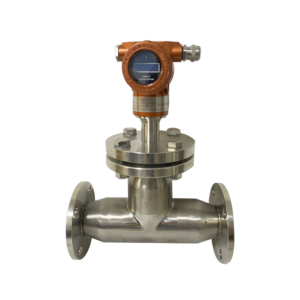
Non Nuclear Density Measurement vs Nuclear: Head-to-Head Comparison
When evaluating non nuclear density measurement against traditional nuclear gauges, chemical plant engineers should consider the following factors:
| Criterion | Non-Nuclear (Tuning Fork / Ultrasonic) | Nuclear (Radiometric) |
|---|---|---|
| Accuracy | ±0.001 to ±0.005 g/cm³ (tuning fork) | ±0.001 to ±0.01 g/cm³ |
| Density Range | 0 to 3 g/cm³ (typical) | 0 to 5 g/cm³ |
| Regulatory Burden | None | Radiation license, annual audits, source disposal |
| Installation Time | 1-2 days | 2-4 weeks (permitting dependent) |
| 5-Year TCO Estimate | 1.0× (instrument + installation + maintenance) | 2.5-3.0× (instrument + permitting + compliance + disposal) |
| Safety Equipment Required | Standard PPE | Radiation badges, exclusion zone signage, leak test kit |
| Operator Certification | None | Radiation safety officer training (annual renewal) |
| Source Disposal Cost | Not applicable | 15-30% of original instrument cost |
| Process Temperature Limit | Up to +200°C (LONN-700S) | Up to +200°C |
| CE/ATEX/IECEx Available | Yes (Ex d IIC T6) | Yes (but source handling restrictions apply) |
| Remote Monitoring | 4-20mA + RS485 Modbus RTU | 4-20mA |
The regulatory advantage alone is often decisive: eliminating radioactive sources removes the need for NRC/IAEA reporting, annual source leak tests, and the engineering overhead of managing a radiation safety program.
How Non Nuclear Density Measurement Works — Technical Overview
Tuning Fork Technology (Vibrating Element Method)
LONNMETER’s tuning fork density sensors (LONN-700CM, LONN-700C, LONN-700S series) operate on a well-established principle: two fork tines are excited at their natural resonant frequency, which changes as the surrounding fluid density changes. The relationship between resonant frequency (f) and fluid density (ρ) follows:
ρ = A × (1/f²) + B
where A and B are calibration constants determined during factory calibration using two reference fluids (typically pure water and air, or a certified density standard).
Key technical specifications from LONNMETER’s installed base:
- Accuracy: ±0.002 g/cm³ (standard), ±0.001 g/cm³ (precision calibration) — see the LONN-700CM tuning fork density meter
- Repeatability: ±0.0005 g/cm³
- Density range: 0 to 2 g/cm³ (extendable to 3 g/cm³ on request)
- Process temperature: -50°C to +200°C (LONN-700S high-temp variant)
- Process pressure: Up to 40 bar (580 psi)
- Wetted materials: 316L stainless steel (standard), Hastelloy C-276, Titanium Grade 2, Zirconium 702, or ceramic-coated (LONN-700C)
- Process connection: Tri-clamp, ANSI flange, or threaded (1″ NPT / 1.5″ NPT)
- Output signals: 4-20 mA (HART), RS485 Modbus RTU
- Ex certification: Ex d IIC T6 (gas), Ex tb IIIC T85°C (dust)
- Ingress protection: IP67 (standard), IP68 (optional submersion)
Ultrasonic Acoustic Impedance Method
For applications where insertion into the process pipe is undesirable or where combined density and concentration data is needed, LONNMETER’s LONN-7000 insert ultrasonic density concentration meter uses acoustic impedance measurement. This technology is particularly effective for acid concentration monitoring, where the relationship between density and concentration follows a well-characterized curve.
Chemical Industry Applications of Non Nuclear Density Measurement
Sulfuric Acid (H₂SO₄) Concentration Control
Sulfuric acid concentration measurement is one of the most common chemical industry applications for non nuclear density measurement. The density of H₂SO₄ varies predictably with concentration across the full range (0-100%), with the well-known peak at approximately 98% (density ≈ 1.84 g/cm³ at 20°C).
Typical installation scenario: In a sulfuric acid regeneration plant, the LONN-700CM tuning fork density meter is installed in a bypass loop after the acid concentrator. At 93-98% H₂SO₄ concentration and 40-60°C process temperature, the instrument provides continuous real-time output with ±0.001 g/cm³ accuracy, corresponding to approximately ±0.05% concentration resolution. The 4-20 mA signal feeds directly into the DCS for automatic dilution control.
Key consideration for H₂SO₄ service: At concentrations above 93%, carbon steel is acceptable for piping but the sensing element must be 316L or Hastelloy to prevent intergranular corrosion. The LONN-700C variant with ceramic-coated fork tines provides additional corrosion resistance in high-temperature acid service.
Caustic Soda (NaOH) Density Monitoring
In chlor-alkali plants producing 50% NaOH solution, density monitoring is the primary method for concentration verification. Non nuclear density measurement offers a distinct advantage here: nuclear gauges often need frequent recalibration due to radiation attenuation fluctuations caused by temperature gradients in the caustic solution.
The LONN-7000 ultrasonic density concentration meter delivers real-time NaOH concentration data with ±0.002 g/cm³ accuracy in the 10-50% concentration range, at temperatures from 20°C to 90°C. The instrument’s acoustic impedance measurement compensates for temperature effects automatically, eliminating the need for separate temperature compensation calculations.
Nitric Acid (HNO₃) Concentration
In nitric acid production, the target concentration is typically 60-68% HNO₃ (azeotropic concentration). The density curve for nitric acid is steep in this range — approximately 0.01 g/cm³ per 1% concentration change — making tuning fork density measurement ideal for process control. The LONN-700S split-type density meter, with electronics mounted remotely from the sensor, is preferred in nitric acid service where the warm acid (40-50°C) creates challenging ambient conditions for the transmitter electronics.
Hydrochloric Acid (HCl) Monitoring
Unlike H₂SO₄ and NaOH, hydrochloric acid density peaks at approximately 38% concentration and decreases beyond that point. This non-monotonic behavior means density measurement alone is insufficient for concentration determination above 38%. In such cases, the LONN-7000 ultrasonic density meter can detect acoustic impedance changes that differentiate between high-concentration HCl and lower concentrations — providing reliable concentration data across the full 0-38% range.
The Regulatory Landscape Driving Non-Nuclear Adoption
Multiple regulatory and market forces are accelerating the transition from nuclear to non nuclear density measurement:
- IAEA Security Recommendations (2020) — Strengthened guidelines for radioactive source physical protection
- US NRC Regulatory Guide 5.73 — Heightened source accountability requirements
- EU Council Directive 2013/59/Euratom — Reduced dose limits for the public and workers
- International Chemical Industry Safety Initiatives — Voluntary programs to reduce radiological hazards (e.g., Responsible Care®)
- Waste Disposal Cost Escalation — Disposal costs for Category 3 sources (typical for density gauges) have increased 40-60% since 2018
These regulatory changes have direct operational implications. A chemical plant operator who replaces a nuclear density gauge with a non-nuclear alternative can typically eliminate two days per month of radiation safety administrative work, freeing engineering resources for process improvement.
Selection Guide: Choosing the Right Non Nuclear Density Technology
| Application | Recommended Technology | Recommended Model | Key Selection Criteria |
|---|---|---|---|
| H₂SO₄ 93-98% concentration | Tuning fork | LONN-700CM (316L) | High accuracy ±0.001 g/cm³, Ex d IIC T6 |
| H₂SO₄ with chloride contamination | Ultrasonic or ceramic fork | LONN-700C (ceramic) or LONN-7000 ultrasonic | Corrosion resistance to chlorides |
| NaOH 10-50% concentration | Ultrasonic | LONN-7000 | Temperature compensation, no fouling |
| High temperature >150°C | Tuning fork (split) | LONN-700S | Remote electronics, sensor up to +200°C |
| Abrasive chemical slurry | Tuning fork (ceramic) | LONN-700C | Orange ceramic coating, wear resistant |
| Batch reactor with frequent CIP cleaning | Tuning fork (sanitary) | LONN-700CM (Tri-clamp) | 316L sanitary finish, Tri-clamp connection |
| Alcohol / solvent recovery | Tuning fork | LONN6004 | Pre-calibrated curves for ethanol-water |
Installation and Maintenance Best Practices
Based on field experience across hundreds of chemical plant installations, the following guidelines maximize non nuclear density measurement reliability:
Installation considerations:
- Install in vertical upward flow where possible to prevent air/gas accumulation on the fork tines
- Maintain minimum 10 pipe diameters of straight run upstream from the sensor
- Avoid installation directly downstream of control valves, pumps, or pipe elbows
- For the LONN-700S split variant, locate the transmitter electronics at least 3 meters from the sensor in high-temperature or high-vibration environments
- Ground the sensor housing to plant earth ground to prevent electrochemical corrosion
Maintenance requirements:
- Tuning fork density meters require no routine mechanical maintenance (no moving parts to wear)
- Factory calibration stability is typically ±0.0005 g/cm³ over 5 years
- Fork tine inspection recommended annually in abrasive or scaling service
- For ceramic-coated forks (LONN-700C), inspect coating integrity during scheduled plant turnarounds
Frequently Asked Questions
What is non nuclear density measurement and how does it work?
Non nuclear density measurement uses mechanical or acoustic principles — such as vibrating tuning fork resonance or ultrasonic acoustic impedance — to determine fluid density without radioactive sources. A tuning fork density meter measures the resonant frequency shift caused by changes in fluid density, while ultrasonic instruments measure acoustic impedance of the process fluid.
Is non-nuclear density measurement as accurate as nuclear?
Yes, for most chemical applications. Tuning fork density meters typically achieve ±0.002 g/cm³ accuracy (and ±0.001 g/cm³ with precision calibration), which equals or exceeds the accuracy of nuclear density gauges in the 0-2 g/cm³ density range. Nuclear gauges maintain an advantage only at very high densities (>3 g/cm³) or in applications requiring measurement through thick-walled vessels where non-nuclear insertion is impractical.
What are the disadvantages of non-nuclear density meters?
The primary limitations are: (1) tuning fork sensors require direct contact with the process fluid (unlike non-contact nuclear gauges through pipe walls), (2) maximum density range is typically 3 g/cm³ versus 5 g/cm³ for nuclear, and (3) tuning fork instruments are sensitive to excessive vibration or heavy fouling/scaling on the fork tines.
How much can a chemical plant save by switching to non-nuclear density measurement?
Based on total cost of ownership analysis, a chemical plant operating 10 nuclear density gauges can expect annual savings of $80,000-$150,000 through elimination of radiation compliance costs, licensing fees, and safety officer training. The payback period for replacing nuclear with non-nuclear instruments is typically 12-24 months.
What safety certifications are available for non-nuclear density meters?
Non-nuclear density instruments can carry the same process safety certifications as any industrial instrument: ATEX (Ex d IIC T6 for gas environments, Ex tb IIIC for dust), IECEx, SIL (Safety Integrity Level) certification to IEC 61508, and CE marking per EU directives.
Can a non-nuclear density meter replace a nuclear gauge without process modification?
In most cases, yes. Tuning fork density meters are installed directly in the process pipe via a flange, tri-clamp, or threaded connection. A typical replacement involves installing the sensor in an existing instrument tee or bypass loop previously used by the nuclear gauge. Since the output signal (4-20 mA) is the same, no DCS configuration changes are required.
Why LONNMETER for Non Nuclear Density Measurement?
LONNMETER specializes exclusively in non-nuclear density and concentration measurement technology. Unlike general process instrumentation manufacturers who offer nuclear and non-nuclear options, LONNMETER’s product line is built entirely around safe, sustainable, non-nuclear measurement:
- Dedicated non-nuclear focus: All R&D, calibration, and application engineering resources are focused on tuning fork and ultrasonic technologies
- Full material range: 316L, Hastelloy C-276, Titanium Grade 2, Zirconium 702, and ceramic-coated fork tines for chemical service
- Real-world accuracy: ±0.002 g/cm³ standard, ±0.001 g/cm³ with precision calibration — verified in hundreds of chemical plant installations
- Global certifications: CE, ATEX Ex d IIC T6, IECEx, SIL — fully compliant for hazardous chemical processing environments
- Application engineering support: Direct access to application engineers with chemical industry experience
Request a Quote
Need a non-nuclear density measurement solution for your chemical process? Contact our application engineering team to discuss your specific requirements — density range, process temperature, pressure, chemical composition, and installation constraints.
Email: anna@xalonn.com
Brand: LONNMETER | smartmeasurer.com
All LONNMETER non-nuclear density meters are manufactured in ISO 9001 certified facilities. CE and ATEX certifications available for all models. Lead time: 2-4 weeks standard, expedited options available.