
Most density problems on a hot line are not density problems. They are temperature problems wearing a density costume. The fluid at 200 °C is not the fluid in the spec sheet — it is lighter, thinner, and in a hurry to drift — and unless the measurement accounts for that, the number on the screen is describing a liquid that stopped existing somewhere upstream. This is the part of picking a high-temperature density meter that gets skipped in the catalogue and lived through in the field.
IMG 3268 scaled

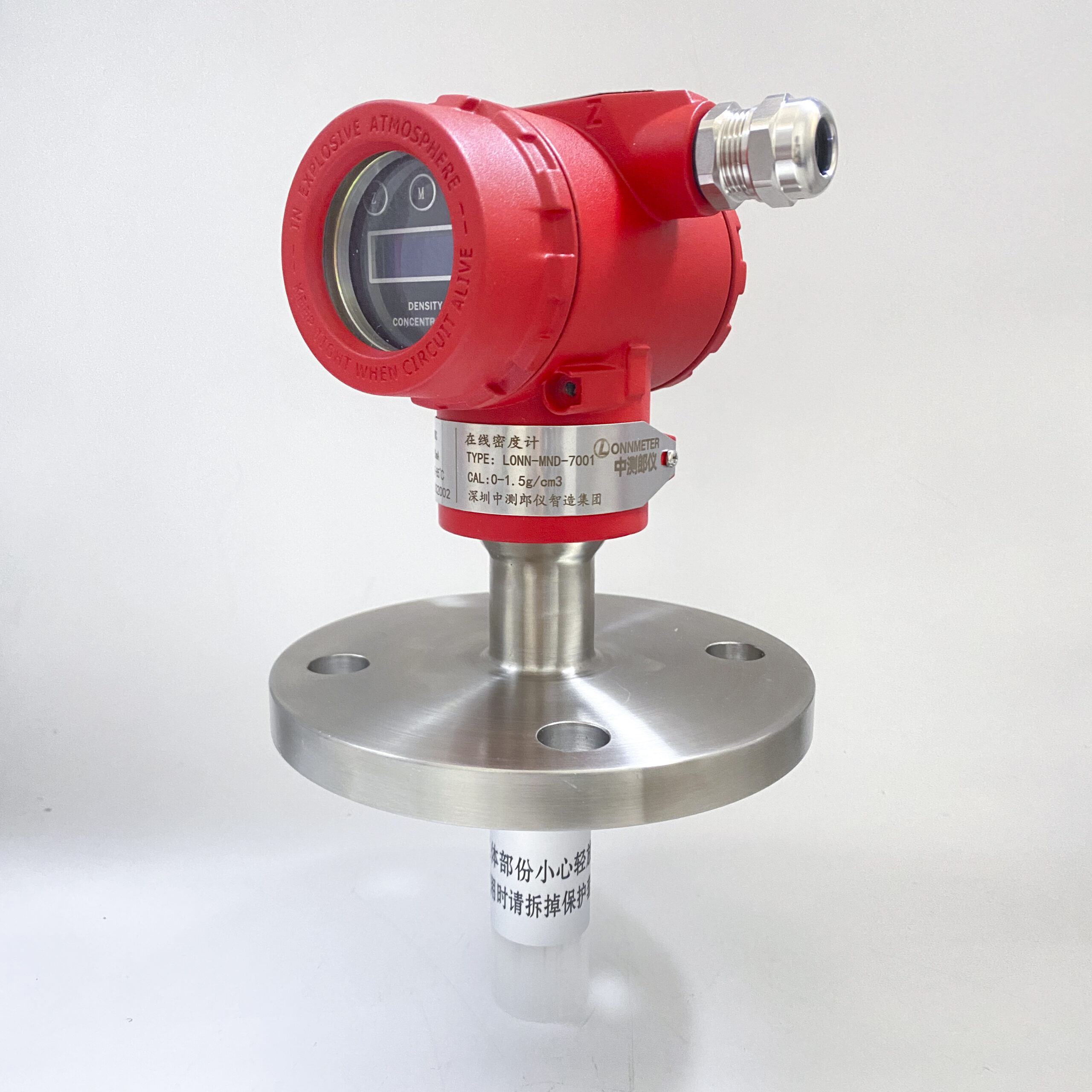
A flanged tuning-fork transmitter built for hard duty. On hot lines the wet-end rating and the remote-head choice decide whether it reads or quietly dies — temperature ratings are confirmed per model and order, not assumed.

We have watched more hot-line density failures come from a baked oscillator and an uncorrected temperature than from a faulty sensor. So before anyone argues about fork versus Coriolis, it is worth being clear about what the heat is actually doing to the reading.

The fluid you measure at 200 °C is not the one in the spec sheet

Density is temperature-coupled for almost everything that moves through a process line. Heat a hydrocarbon and it expands; cool it and it contracts. The shift is not small — for many hot oils and asphalt streams it is the difference between on-spec and a tank you have to re-blend. A density reading taken with no temperature correction is a reading about a different fluid than the one in the pipe.

A hot-line density number without a temperature correction is not wrong. It is just answering a question nobody asked — “what does this fluid weigh at some other temperature?”

This is why high-temperature density meter is really a placement-and-compensation problem, not a "what survives the heat" problem. For high-temperature density meter, the instrument can be rated to 300 °C and still lie to you if the correction is built on a temperature read three metres away, or skipped entirely because "the DCS already has a temperature tag." It does not. Not at the density point it does not.

Where the heat actually breaks the reading

People blame the sensor. Usually the sensor is fine and the surroundings are not.

The wet-end and the oscillator drift apart

A fork or tube that is rock-stable at 25 °C can creep at 200 °C if it was not designed for it. The resonant parts expand, the materials relax, and the zero walks. For any high-temperature density meter the wet-end material and the oscillator housing are the first things to check, not the last — and the supplier's rated maximum is the line you do not cross, not a suggestion.

Every seal is working at its worst point

Where the sensor meets the pipe, every joint is on the nasty part of its curve. Heat softens elastomers, accelerates creep, and punishes a sloppy install. A method that keeps the measuring element away from the heat — or uses a properly rated high-temperature seal — earns its keep here. A leak on a 200 °C line is not a maintenance ticket; it is an incident.

The quiet failure mode: running a wet-end past its rated temperature does not fail loudly. It drifts, slowly and silently, until someone notices the blend is off a month later. Stay inside the rating and log it.

Viscosity moves, and takes the reading with it

Heat collapses viscosity, and viscosity changes how a vibrating element behaves. A density cell that does not account for the temperature-driven viscosity shift will read density through a viscosity error it never admits to. This is the trap on hot, thick fluids — bitumen, heavy crude, polymer — where the viscosity swing across the operating range is enormous.

The electronics cannot sit in the heat

The clever part of any density meter — the oscillator, the converter — hates heat. Real designs either move those parts away from the pipe on an extension, or keep the process connection short and the head cool. An instrument with its converter baking next to a hot line is an instrument with a short, unhappy life, and the drift shows up in weeks, not years.

Four ways plants read density while it is hot

There is the offline sample, and then there are the inline options — each carrying the same temperature caveat, none of them universally right.

Draw, cool, weigh (the lab memory)

The classic move: pull a sample, cool it, weigh it in a pycnometer or density bottle at a known temperature. Accurate, traceable, necessary for audit. But it measures the cold version of a hot fluid, one moment after transport. For calibration and the reference number it is indispensable; for live control of a hot line it is a memory of what the fluid used to be.

Tuning-fork with a high-temperature extension
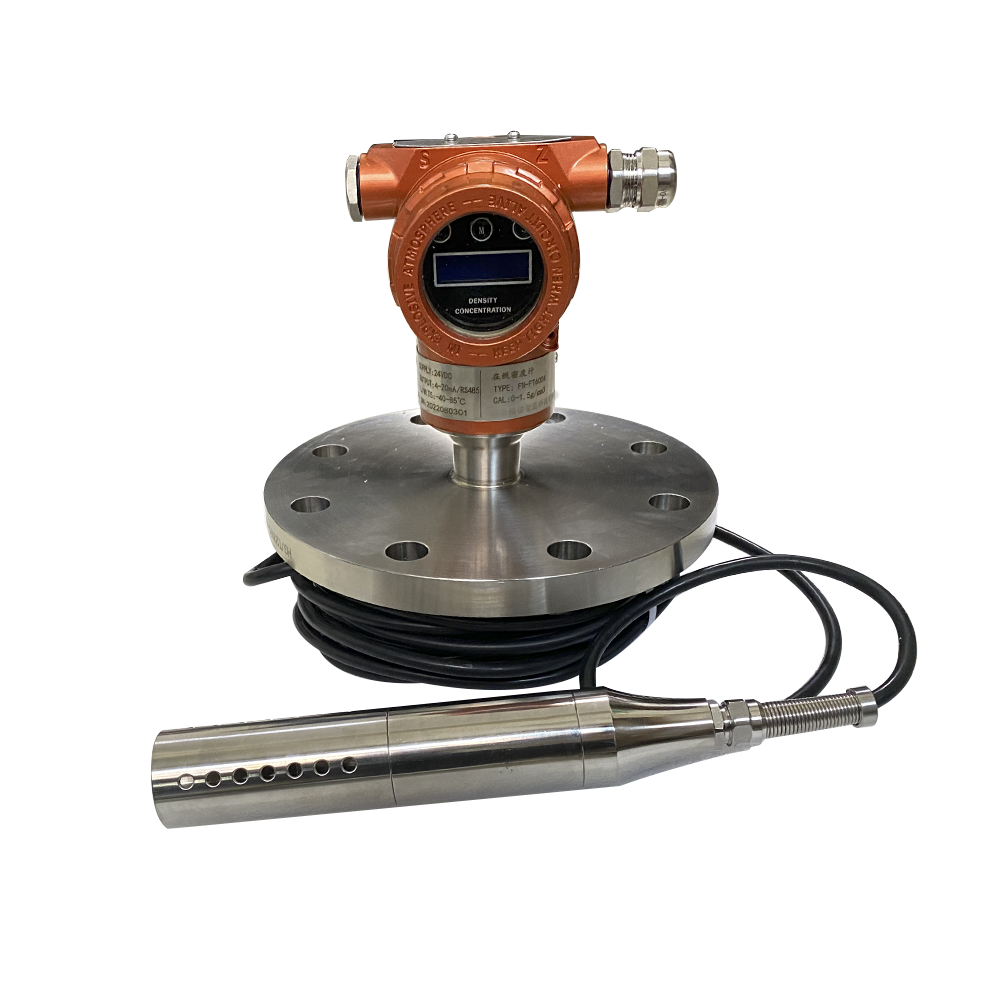
A tuning-fork density meter can be built for heat: a rated high-temperature wet-end plus a remote transmitter on an extension that keeps the electronics off the pipe. For high-temperature density meter on hot-oil, asphalt, and chemical streams, this is the practical inline choice — compact, fast, no process opening to leak, oscillator parked where it stays cool. The real limit is the wet-end rating, and the supplier’s figure is the line.

tuning fork density meter

A tuning-fork transmitter on a high-temperature extension: the wet-end meets the hot line while the converter sits cool at the remote head. This split is what lets the same cell survive a line it would never survive with the head bolted to the pipe.

Coriolis — designed around the heat from the start

A Coriolis meter is, in many ways, the natural instrument for high-temperature density meter. It is built around a vibrating tube in the stream and has always been offered in high-temperature versions because its users have always needed them. Where you also need mass flow, you get both from one device — elegant on a metered hot product line. The catch: on a line you cannot isolate, the tube and its welds take the full thermal load, so access for inspection still matters.

Clamp-on ultrasonic, and nuclear at the far end

A clamp-on ultrasonic density meter couples to the pipe exterior and infers density from the acoustic path — nothing in the fluid, attractive on a hot, hazardous, hard-to-cut line. The limit is the wedge: ultrasonic wedges have a temperature ceiling well below a metal wet-end, so for genuinely high-temperature density meter this method drops out sooner than the fork or the Coriolis. A gamma gauge, by contrast, reads attenuation and does not care how hot the stream is — but it needs a radiological license, shielding, and a safety program, so it earns a place only at the hostile end where nothing else survives.

Match the method to what the line actually does

A framework for high-temperature density meter, not a brochure:

  • Metered hot product line, also need flow → high-temperature Coriolis. Flow and density from one device, one weld.
  • Hot line, no appetite to cut in, moderate temperature → tuning-fork with a high-temperature extension and remote transmitter. Keep the electronics cool, keep the opening sealed.
  • Very hot, hazardous, or no access for a process opening → clamp-on ultrasonic if inside its wedge limit; nuclear where the radiological program already exists.
  • Hottest, most hostile line where nothing else lives → nuclear, if licensed.
  • The reference number nobody argues with → keep the cooled, lab-measured sample. Inline controls; the lab proves.

The density meter selection guide expands this into a full decision table, and the inline measurement methods guide puts the technologies side by side. Where both flow and density are on the table on a hot line, the inline versus Coriolis comparison is the right read, and the non-nuclear density measurement in the chemical industry piece covers wet-end materials for high-temperature hazardous streams more broadly. For the published temperature ratings, our inline density meter range lists them per model.

Ceramic Tuning Fork Density Meter3

An inline density and concentration transmitter on a process line: one device covering the density and related read the controller needs, with the head kept clear of the heat. The mount, not the badge, is what decides whether it reads true.

The install details that decide read-or-drift

The placement rules for high-temperature density meter are the same as any inline install, plus a few heat-specific ones that get ignored until they bite:

  1. Keep the electronics cool. Extension or remote transmitter, converter off the pipe. Baking the oscillator is the fastest route to drift we know of.
  2. Read temperature at the density point. Density is temperature-coupled; a correction built on a temperature read metres away carries the wrong gradient. Measure it where the cell is.
  3. Respect the wet-end ceiling. Every high-temperature wet-end has a rated maximum. Past it, no loud failure — just quiet drift. The supplier’s figure is the number.
  4. Seal for the temperature. Rate the seals and joints for the duty. On a hot line the seal fails first and loudest.
  5. Avoid the hot spots. Mount away from local superheat, steam blanketing, wall-temperature spikes. The cell should see the bulk fluid, not a hotspot.
  6. Calibrate against a cooled reference on the cycle. Heat introduces slow drift; a periodic cooled-sample check is the independent proof the inline cell has not moved.

From the field: one site bolted a remote transmitter into the insulation behind a hot header “to save cable.” Three months later the oscillator had drifted past the process tolerance and nobody had a baseline to compare it against — because the cooled-sample check had been dropped to save time. The fix was a longer extension and reinstating the sample, not a new sensor.

Things we keep finding on failed hot-line installs

Same errors on high-temperature density meter installs, plant after plant. None of them is the instrument:

  • Density read with no temperature. A value with no correction on a hot line is a value for a different fluid. Always correct, or always read together.
  • Electronics left in the heat. A remote head beaten into a hot location drifts within months. Use the extension.
  • Wet-end limit crossed. Looks fine until the numbers drift. Stay inside the rating.
  • A seal that was not rated for the temperature. On a hot line it fails first and loudest. Rate it for the duty.
  • No cooled reference kept. Running inline with no lab check means you never know if thermal drift crept in. Keep the sample as the proof.

If your hot line is fighting a density reading that will not hold, talk to our application engineers about the wet-end rating and the transmitter location before you buy. Most high-temperature density meter problems are solved in the mount and the cooling, not the brochure — and the density measurement hub gathers the method and application guides these choices build on.

How we spec, characterise, and verify: every transmitter we build is characterised against the method bases we work to — ISO 15212 for vibrating density meters and ASTM D4052 for digital density measurement — and the temperature compensation follows the same physical basis. That is also why we insist the temperature be read at the density point, not borrowed from a DCS tag down the line: the standard and the field agree, and so should the number. Ratings quoted in this guide are method-level; the figure for your exact model is the one on the published datasheet.


LONNMETER GROUP designs, manufactures, and supports inline density, viscosity, and concentration instruments for industrial process lines. This article is informational; temperature ratings and specifications vary by model and must be confirmed against the published datasheet before selection.

Leave a Reply

Your email address will not be published. Required fields are marked *