
Treating HCl concentration as a titration problem works in the lab and fails on a running line. A titration tells you what the sample was; it cannot tell the dosing pump what to do next. On a continuous acid line, HCl concentration measurement has to be a live loop variable — read it where the acid flows, and let it drive the addition in the same minute the strength drifts. The interesting part is not the sensor. It is choosing which physical property to infer the concentration from, and surviving the corrosiveness long enough to trust the number. For most plants, the first HCl concentration measurement decision is not which meter to buy, but which property to infer the strength from.

Why acid strength is a process variable, not a lab result

Hydrochloric acid sits in the middle of more processes than people expect: steel pickling, chlor-alkali, pH neutralization, fertilizer, and acid regeneration. In every one of them, the concentration sets three things at once — reaction yield, how much counter-agent you burn to neutralize, and how aggressively the stream attacks its own piping. A half-percent miss on strength quietly overspends caustic downstream, or leaves a pickling bath too weak to clean the strip.

The usual failure mode is clock, not chemistry. A grab sample titrated off-line returns the answer an hour after the tank moved on. By the time the lab calls, the off-strength acid is already in the next batch. That lag is exactly why HCl concentration measurement keeps getting re-framed as a control problem rather than an analysis problem: the value only matters if it arrives before the decision it is meant to inform.

There is no direct "concentration probe" for HCl

No inline instrument counts HCl molecules directly. Every continuous method measures a physical property of the solution — density, electrical conductivity, or refractive index — and converts it to concentration through a relationship that is specific to hydrochloric acid. The concentration measurement applications overview lays out where this inference approach is used across process acids.

The quality of the final number depends as much on that relationship and its temperature correction as on the sensor hardware. Treat the conversion table as part of the instrument, because functionally it is.

Density-derived concentration: the workhorse for HCl
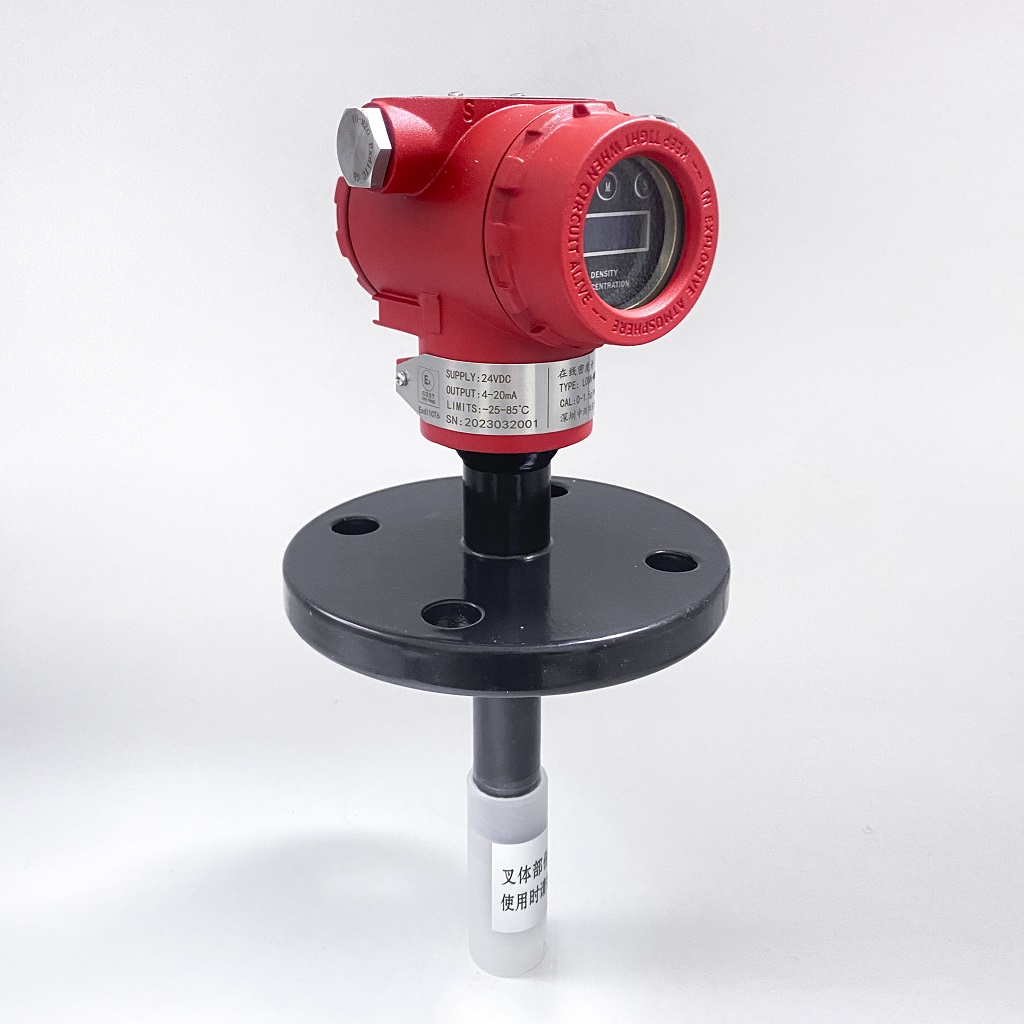
For hydrochloric acid, density is the most dependable proxy. The relationship is steep, well characterized, and nearly monotonic across the commercial range — at 20 °C, roughly 10% HCl sits near 1.047 g/cm³ and 30% near 1.149 g/cm³. That density-to-concentration link is even codified as a standard method (China’s GB/T 32158.1 for determining HCl concentration by the density method; vibrating-element meters are covered by ISO 15212). A tuning-fork density meter or a Coriolis density meter reads density continuously and, with the acid’s density–concentration table loaded, outputs percent HCl live. This is why HCl concentration measurement by density has become the default on single-acid lines rather than a specialist option.

The real constraint on HCl concentration measurement by density is the wetted parts, not the physics. Strong acid eats ordinary metals, so the measuring element has to be PTFE, Hastelloy, or ceramic faced. A PTFE-clad fork or a ceramic-protected element is the difference between a meter that runs for years and one that is a corrosion statistic by the next shutdown. The non-nuclear density measurement for chemical industry guide explains why plants increasingly avoid radiometrics on acid service.

Verification matters more than people admit. Because the concentration is inferred, the density–concentration table should be confirmed against reference titrations at several points across the operating band and temperature range — exactly the discipline GB/T 32158.1 builds around. A meter left on a single factory point will quietly drift the moment the acid grade changes.

The limitation worth stating. Density tracks concentration well, but it is a single-property inference. If the acid is contaminated with other dense species, the number drifts from true HCl strength. For the usual single-acid stream, that is a non-issue; for mixed or unknown liquors, keep a lab cross-check.

HCl concentration measurement

Conductivity: cheap and fast, with a hard ceiling

Conductivity is the simplest way to infer acid strength, and for dilute HCl it is genuinely good. Acid ionizes strongly, so even small concentration changes move the reading. An electromagnetic-induction variant measures without contacting the liquid at all, which is attractive on a fluid this corrosive.

But conductivity saturates. Above roughly 20% HCl the curve flattens, and the reading loses sensitivity exactly where concentrated acid lives. It is also blind to non-ionic contaminants and sensitive to temperature. So HCl concentration measurement by conductivity is a dilute-acid tool — excellent for a rinse or a plating bath in the low single digits, weak for anything approaching concentrated.

Refractometry: sharp where conductivity fades

A refractometer reads concentration off the refractive index using a sapphire prism in contact with the acid. For aqueous HCl it responds sharply across a wide band (roughly 5% to near saturation) and, because it uses only the reflected beam, it shrugs off bubbles, color, and suspended solids that would confuse other methods. Temperature still has to be compensated, but the optical path is forgiving.

Where refractometry loses to density is at the very high end and on cost of ownership in heavy service — the prism face is a wear and coating surface. For a clean, mostly-liquid HCl stream it is a strong contender; for a gritty or fouling line, density usually wins on uptime.

How the three compare on HCl

MethodBest rangeWhat it needsWhere it struggles
Density (fork / Coriolis)Wide, incl. concentratedCorrosion-resistant wetted parts (PTFE, Hastelloy, ceramic)Single-property inference; mixed liquors
ConductivityDilute (≤~20%)Electrodes or induction coilSaturates at high concentration; ion interference
Refractometry~5% to near saturationSapphire prism, temp compensationPrism coating on foulants; high-end cost

None of the three is “the HCl meter.” The chemistry and the concentration band pick the method, and the duty picks the material. The inline density versus Coriolis comparison is useful when you are deciding whether you also need mass flow, or just concentration.

The loop is the point, not the reading

A concentration number that nobody acts on is a gauge, not control. The purpose of putting HCl concentration measurement inline is to drive the acid addition pump or valve from the measured strength through the PLC, so the loop corrects within the same minute the concentration moves. Compared with waiting on a titration, the win is a shorter loop — detection and correction on the same timescale as the process.

Feeding that signal into the DCS or PLC is straightforward: most inline transmitters output 4–20 mA or Modbus, and the controller already knows the dosing valve's authority. The harder part is dead time — between the addition point, the mixing section, and the sensor there is genuine transport delay, so tune the loop for the process, not for the meter's update rate.
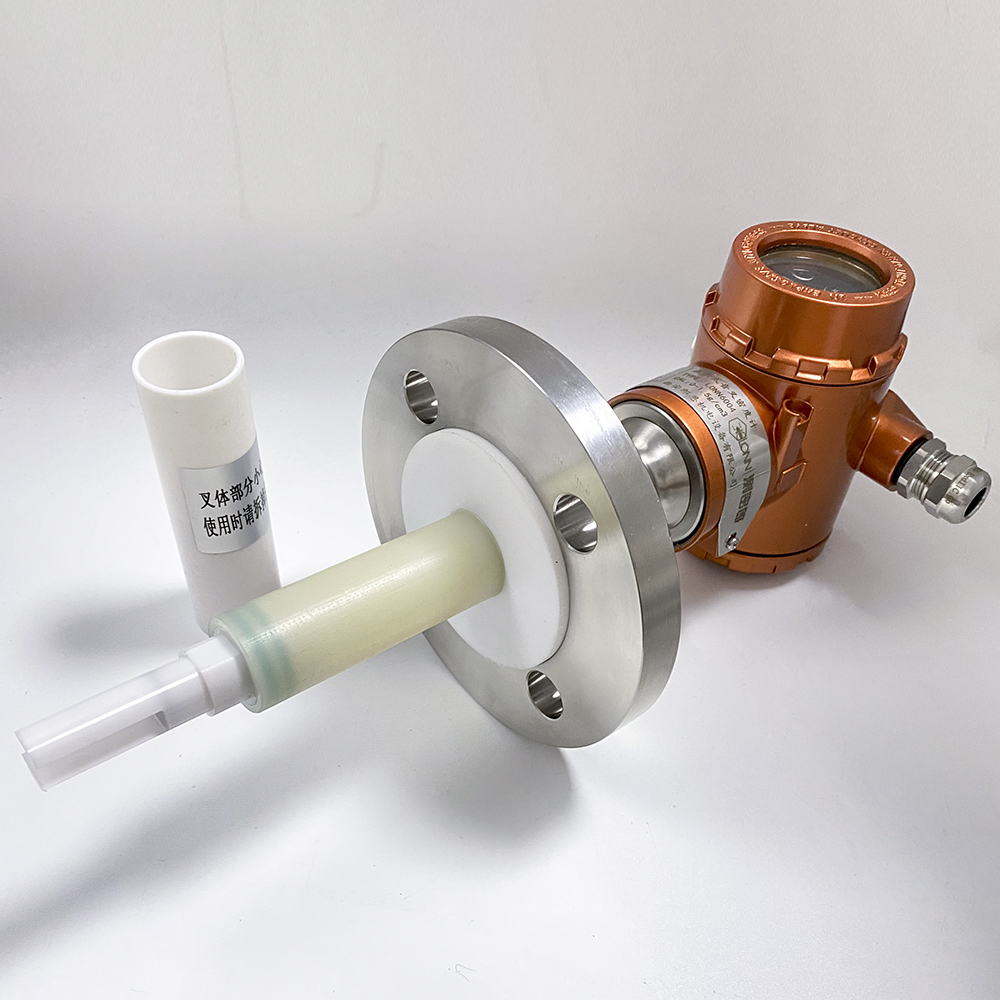
Ceramic Tuning Fork Density Meter

Mistakes that wreck HCl concentration readings

Most HCl measurement failures are material or calibration failures wearing a sensor’s name.

  • Wrong wetted material. Ordinary stainless on HCl is a countdown. The element has to be PTFE, Hastelloy, or ceramic from the start.
  • Skipping temperature compensation. At 30% HCl, density drops about 0.001 g/cm³ per 1 °C; ignoring that is a permanent, silent offset.
  • One table for every recipe. A density-to-concentration curve is acid-specific. The same meter on a different blend needs its own curve, or the number lies the moment the recipe changes.
  • Treating titration and inline as rivals. They are not. Inline gives the control loop; the lab gives the audit. Run both, and trust the inline number because the lab keeps confirming it.

A short selection checklist

Before specifying HCl concentration measurement for a line, answer four questions:

  1. What concentration band? Dilute (≤~20%) favors conductivity on cost; mid-to-concentrated favors density or refractometry.
  2. What is the corrosion duty? Match wetted material to the acid first — PTFE, Hastelloy C, or ceramic — before arguing about principle.
  3. Clean liquid or fouling service? Bubbles and solids push you toward density or induction conductivity; a clean stream opens up refractometry.
  4. Do you need mass flow too? If only concentration, a density meter selection guide steers you to a probe; if you also totalize, a Coriolis meter earns its place.

Answering those four questions is how a sound HCl concentration measurement spec gets written instead of guessed. For the hardware, inline concentration meters built on these principles are the usual starting point, and the density measurement hub collects the underlying technology pages.

Frequently asked questions

What is the most accurate method for HCl concentration measurement?

For a well-characterized single-acid stream, vibrating-density and refractometer methods both hold concentration within roughly ±0.1% HCl across much of the commercial range, with refractometry reaching finer resolution on clean dilute acid. Accuracy depends as much on the temperature-compensated calibration curve as on the sensor.

Can conductivity measure high-concentration HCl?

Not reliably. Conductivity tracks dilute HCl well but flattens above about 20%, losing sensitivity exactly where concentrated acid lives. Use density or refractometry for mid-to-high concentration.

Why does temperature matter so much for HCl concentration?

Both density and refractive index shift with temperature — at 30% HCl, density falls about 0.001 g/cm³ per 1 °C. An uncompensated reading carries a permanent offset larger than the sensor’s own error, so the mixture’s temperature-corrected curve is mandatory.

Is a density meter enough for HCl, or do I need refractometry?

For a clean single-acid stream, a corrosion-resistant density meter is usually enough and doubles as a flow totalizer in Coriolis form. Choose refractometry when you need finer resolution on dilute, clean acid and want immunity to bubbles and color.

Do I still need lab titration if I measure HCl inline?

Yes, as an audit, not a rival. Inline gives the real-time control loop; periodic titration or a reference check confirms the curve and catches contamination. The two together are what make the inline number trustworthy.

About LONNMETER GROUP. We design, manufacture, and support inline density and concentration instrumentation for corrosive chemical service. Our PTFE- and ceramic-wetted tuning-fork and Coriolis density meters are widely used as inline HCl concentration analyzers on single-acid streams. This guide is informational and does not replace the procedure supplied with your instrument; reference values, wetted-material ratings, and temperature limits should always be confirmed against the device datasheet. Standards referenced in our measurement work include ISO 15212 (vibrating density meters) and China’s GB/T 32158.1 (determination of HCl concentration by the density method), which underpin the density-to-concentration inference described here.

Explore the concentration measurement cluster or talk to our application engineers about a method matched to your acid and concentration band.

Leave a Reply

Your email address will not be published. Required fields are marked *

Request for Quotation

Please provide your application parameters for a technical assessment and formal quote.