
Brix is not a sugar reading. One degree Brix means one gram of sucrose in one hundred grams of solution — a mass-fraction convention, fixed at a reference temperature, that the sugar industry turned into a general scale for dissolved solids. Anything else dissolved in the water alters the same number. That is precisely why inline brix measurement is a conversion problem before it is an apparatus problem: no probe counts sugar molecules, and the two quantities engineers actually measure, refractive index and density, both respond to every solute in the stream. Understand the conversion and the remainder of the specification follows.

What °Bx actually counts


ICUMSA, the International Commission for Uniform Methods of Sugar Analysis, defines the scale against pure sucrose solutions at 20 °C. ISO 2173 uses refractometry to determine soluble solids in fruit and vegetable products; AOAC refractometric methods do comparable work on sugar products. In a cane refinery the number tracks thin juice, evaporator discharge, mother liquor supersaturation, and molasses. A brewery employs the near-identical Plato scale for wort gravity. A tomato concentrate plant uses it for total soluble solids. Near-identical is not interchangeable — at specification level the scales sit on different tables, so quote the basis every time.

Because the scale is calibrated on sucrose, a refractometer result is often called apparent Brix. Fructose, glucose, salts, organic acids and ethanol all shift refractive index. A fermenting wash carrying alcohol will read high on a refractometer even while real sugar falls. Corrected Brix subtracts an acid term in citrus. That is a laboratory convention, not something a bare online probe can invent. The first design question for inline brix measurement is therefore which dissolved species your medium actually holds, and whether one quantity can describe them.

Two physical properties, one number


Both industrial techniques infer °Bx from something else. Refractive index nD increases monotonically with dissolved solids. So does density. At 20 °C a pure sucrose solution moves roughly as follows (approximate values; the ICUMSA table or the curve loaded in your transmitter governs any requirement):

°BxDensity (g/mL, 20 °C)Refractive index nD (20 °C)
0 (water)0.99821.3330
101.03811.3478
201.08101.3638
301.12701.3811
401.17641.3997
501.22961.4200
601.28651.4418
701.34711.4651

Neither column is linear, and the two are not equivalent. A refractometer follows the nD column; a vibrating-element or Coriolis meter follows the density column; each then applies its own temperature-corrected relationship to print °Bx. The density measurement hub collects the technology behind the second route. Treat the curve as part of the instrument. Functionally, it is. Getting inline brix measurement right lives or dies on that table, not on the sensor’s headline accuracy.

Inside a critical-angle process refractometer


An inline process refractometer mounts a sapphire prism flush with the pipe wall, or in a sanitary adapter. A light source sends a beam at the prism–liquid interface; above the critical angle the beam reflects totally, below it light escapes into the fluid. The critical angle equals arcsin(n_liquid / n_prism), so the position of the light–dark boundary on a CCD array yields nD directly. Electronics convert nD to °Bx through the loaded scale and push 4–20 mA, Modbus, or an Ethernet signal to the PLC.

Only a thin layer at the prism face participates. Colour, turbidity and suspended pulp therefore hardly register — the reason critical-angle units dominate dark syrup, yeast-laden wash and juice bases. What does register is anything that coats the prism: sugar film, crystallisation, a protein deposit. Scheduled high-pressure flushing, ultrasonic cleaning, or a wiper is not an accessory on a 65 °Bx concentrate line. It is what keeps the reading stable between CIP cycles.

Automatic temperature compensation supplies the other half. Refractive index declines approximately 0.0001–0.0002 nD per °C for aqueous sugar, so an uncompensated ten-degree swing moves °Bx by a visible fraction of a degree. Compensation uses a temperature measured at the prism plus a sucrose–water chart. It stays valid only while the stream really behaves like sucrose–water.

Inside a vibrating density meter
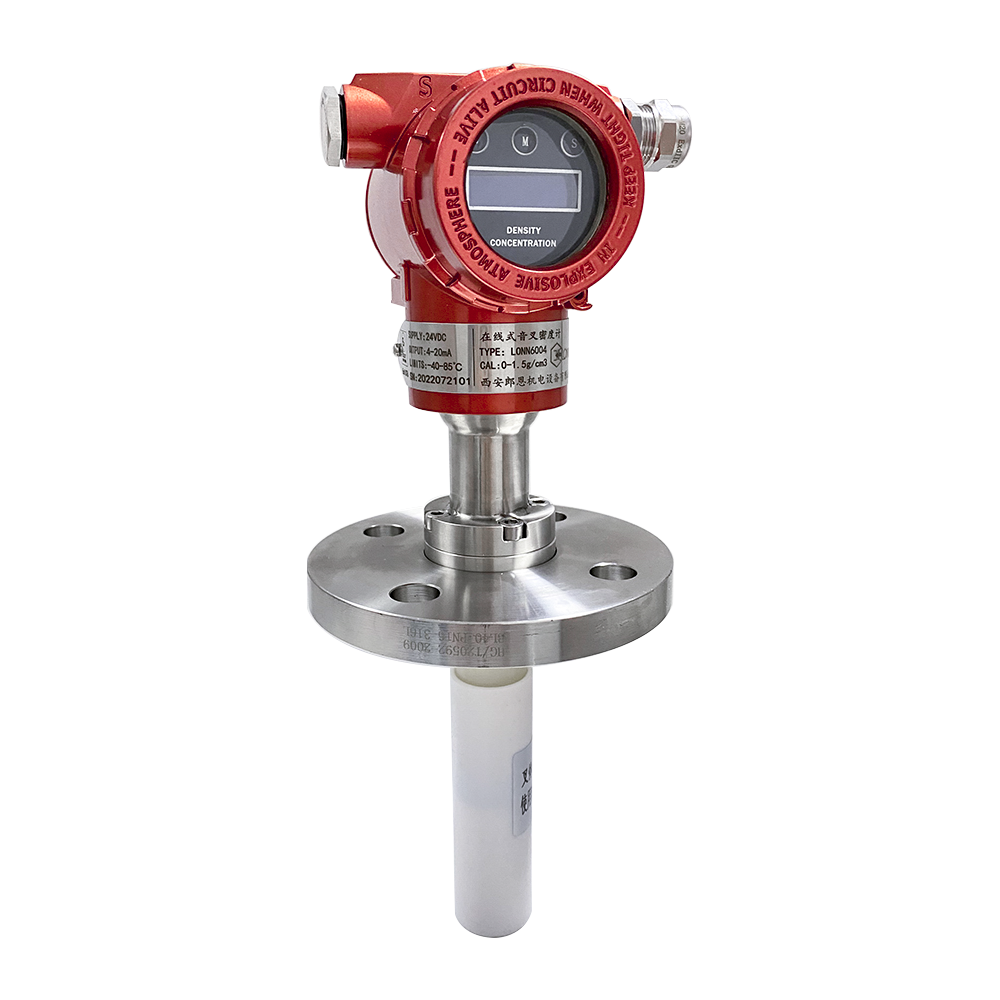

A tuning-fork density meter drives a two-pronged element at resonance with a piezo crystal. Liquid coupled to the forks adds moving mass, and the resonant frequency drops as density climbs. An embedded Pt100 reads process temperature at the same point. The transmitter converts frequency plus temperature into density, then into °Bx from the sucrose table. ISO 15212 covers vibrating-element density meters; ASTM D4052 covers digital density measurement in the laboratory.

Ceramic Tuning Fork Density Meter4

A Coriolis meter takes density from the resonant frequency of its measuring tubes and delivers mass flow from their phase shift at the same time — useful when a blending skid also needs to totalize sugar mass. The inline versus Coriolis comparison is the short version of that trade-off. Both approaches ignore colour and opacity, which is why inline brix measurement on dark molasses often ends up a density job rather than an optical one.

Entrained air is the enemy here. A bubble clinging to a fork lowers apparent density and prints a Brix value that is simply incorrect. Mount where the line runs full and the flow is representative, downstream of pumps rather than in a suction leg. One more difference from optics: a density meter weighs everything in the liquid, suspended solids included, so a pulp-heavy juice requires its own correlation.

Where the conversion table comes from


Two curves have to be right. The first maps the measured property to density or nD. The second maps that property to °Bx at the measured temperature, and this is where most specifications silently go wrong. ICUMSA tables describe pure sucrose in water. High-fructose corn syrup, honey, malt wort and tomato serum each reside on a different curve, so a factory sucrose table loaded into a transmitter will display a plausible quantity that does not match a laboratory Brix on those products.

Calibration closes the gap. Zero the instrument on water at a known temperature, then check several points across the operating band against a bench refractometer or a prepared sucrose standard, and fit a product-specific curve. Keep the lab technique as an audit rather than a rival; the inline versus laboratory comparison explains why two correct readings can still disagree. That audit loop is what makes inline brix measurement defensible when a customer or an auditor asks how the number was produced.

Temperature compensation deserves the same skepticism. A single coefficient held across 0–70 °Bx and 20–90 °C cannot reproduce a two-dimensional matrix. Ask to see the compensation grid. Validate that the temperature sensor resides at the measuring element, not metres away in a cooler run of pipe. These are datasheet queries; published accuracy figures assume them.

Two routes, compared


Choosing between optics and density is less about accuracy than about what else is in the pipe.

 Critical-angle refractometerVibrating / Coriolis density
ReadsnD at the prism faceBulk density of the whole fluid
Unaffected byColour, turbidity, suspended solidsColour, opacity, moderate fouling
Disturbed byPrism coating, crystallisation, filmEntrained gas, bubbles, viscosity at high °Bx
TemperatureATC on a sucrose–water tablePt100 at the element plus a density table
Also givesProcess temperatureMass flow (Coriolis only)
Usual fitClear to pulpy juice, syrup, wort, evaporationDark molasses, opaque streams, blending skids

Neither wins everywhere. A clear apple juice concentrate is textbook refractometer duty; a dark, gas-streaked molasses line usually belongs to a density element. The inline density measurement methods guide walks through the same split on other fluids, and the density meter selection guide turns it into a specification. At a facility with both duties, inline brix measurement is frequently two different instruments under one tag.

The number is a contract, not a reading. °Bx printed by an online analyser is defined by the curve loaded into it. Two correctly functioning instruments on the same pipe can disagree by a degree if one carries a sucrose table and the other a product-specific one. Write the basis — scale, reference temperature, product curve — into the specification.

The concentrate that read two degrees low


A fruit concentrate line held a 65 °Bx endpoint by grab samples and a bench refractometer, and batches swung either side of target. An inline unit went in at the evaporator discharge; for the first week its reading sat about two degrees below the lab. Nothing was wrong with the optics. The tapping point sat beside a dead leg near the vacuum vessel, where flash vapour left a fine stream of bubbles and a sugar film built on the prism between CIP cycles. Moving the sensor to the pump discharge, adding a scheduled prism flush, and checking zero on water each week brought the two numbers into line. Endpoint variability fell with them. The instrument had been measuring the dead leg faithfully the whole time.

dn25 h.17 scaled

Episodes like that are why installation drawings get reviewed before purchase orders. A specification that lists accuracy but says nothing about mounting, cleaning, or the reference approach has not specified inline brix measurement at all.

What breaks the reading


Most of these failures are decisions made upstream of the instrument.

  • Assuming apparent Brix equals sucrose. Alcohol, salts, acids and fructose all move nD. On a fermenting stream use density, a distillation step, or a product-specific model instead of a sucrose refractometer curve.
  • Compensating temperature with the wrong table. Sucrose ATC is not valid for a high-fructose syrup. Measure at the prism or the fork.
  • Letting the prism coat. Film and crystals are the dominant drift mechanism on concentrate lines. CIP, flush or wiper, then verify with a lab check.
  • Mounting in stagnant or aerated flow. Dead legs, pump suction and gas-break points give bubbles plus unrepresentative liquid.
  • Mixing scales. °Bx, °Plato and °Baumé are numerically close in places and defined differently. State the scale on every report.
  • Skipping multipoint verification. One factory point cannot cover a broad band. Check at low, mid and high concentration.

None is a sensor fault. Each is a reason inline brix measurement should be commissioned as a practice — sampling point, cleaning regime, curve, reference check — rather than delivered as a box.

This guide is informational and does not replace the procedure supplied with your instrument. Accuracy, range, wetted-material limits, CIP/SIP temperature ratings and hazardous-area certifications must be confirmed against the device datasheet and the applicable ICUMSA, ISO 2173 or AOAC method before selection.

Specifying the measurement


Six questions settle most of it before hardware enters the conversation:

  1. Which solutes are present? Pure sucrose solution, mixed sugars with acid, or a fermenting wash carrying ethanol.
  2. What band and temperature? 0–15 °Bx thin juice is a different duty from 60–70 °Bx at 80 °C out of an evaporator.
  3. How clean is the stream? Pulp, crystals and protein film push toward density, or a refractometer with active cleaning.
  4. Is mass flow needed? If the skid also totalizes, Coriolis earns its place. If not, a probe does.
  5. What hygiene class? Food duty calls for 316L wetted parts, sanitary adapters and a documented CIP envelope. Powdered-sugar areas may additionally need dust ignition protection — check the hazardous-area classification rather than assuming.
  6. What is the reference method? Name the lab method and the product curve the online indication will be audited against.

The concentration measurement applications overview collects the neighbouring issues, inline concentration meters cover the hardware built on these principles, and our application engineers can match a curve to your product. Answer the six questions first, and inline brix measurement becomes a straightforward specification instead of a quote for a box.

Get the curve and the temperature grid right, keep the prism spotless, and check against the lab on a schedule. That is most of the effort. The rest is wiring the output to the valve that actually controls the evaporator.

Frequently asked questions


What is the most accurate way to do inline brix measurement?

For a clean sucrose or juice stream, a temperature-compensated critical-angle process refractometer typically holds about ±0.1–0.2 °Bx, with a vibrating-density meter in the same class on opaque or gassy liquids. Accuracy depends as much on the loaded product mapping and its temperature correction as on the sensor. Confirm figures against the device datasheet and your reference method.

Can a handheld refractometer replace an inline Brix meter?

No. A handheld or bench refractometer reads a still sample at a controlled temperature; it cannot follow an evaporator endpoint or drive a dilution valve. With inline brix measurement, a continuous 4–20 mA or Modbus signal arrives at the process point, which is what makes closed-loop control possible. Keep the bench instrument as the audit reference.

Why does temperature compensation matter so much for °Bx?

Refractive index falls roughly 0.0001–0.0002 nD per °C, and sucrose solution density shifts roughly 0.0003–0.0006 g/mL per °C depending on concentration. Over a ten-degree swing the uncorrected error exceeds the instrument’s own uncertainty. Compensation needs the temperature measured at the prism or fork and the full sucrose–water table, not a single coefficient. That is why inline brix measurement quotes an accuracy figure only alongside a stated temperature range.

Does inline brix measurement work on dark or pulpy liquids?

Yes, given the right method. Critical-angle refractometry reads only the thin layer touching the prism, so colour, turbidity and suspended pulp barely affect it; a vibrating-density meter ignores opacity altogether. What does matter is prism coating, crystallisation and entrained gas, so specify cleaning and a representative mounting point.

Is °Bx the same as °Plato or specific gravity?

No. °Bx is grams of sucrose per 100 g of solution; °Plato is the brewing scale for wort extract; specific gravity is a density ratio. They are numerically close over parts of the range but sit on different tables, so conversions should use the relevant ICUMSA or brewing table and always state the scale and reference temperature.

About LONNMETER GROUP. We design, manufacture, and support inline density and concentration instrumentation for sugar refining, beverage, brewing, and food processing. Our tuning-fork and Coriolis density meters are widely used as inline Brix analysers where opacity, gas or fouling rules out an optical path. This guide is informational and does not replace the procedure supplied with your instrument; reference values, temperature coefficients, wetted-material limits, CIP/SIP ratings and hazardous-area certifications should always be confirmed against the device datasheet and the applicable ICUMSA Methods Book, ISO 2173 or AOAC method.

Explore the concentration measurement cluster or talk to our application engineers about a curve matched to your product.

Leave a Reply

Your email address will not be published. Required fields are marked *

Request for Quotation

Please provide your application parameters for a technical assessment and formal quote.