
Brix is not a sugar reading. One degree Brix means one gram of sucrose in one hundred grams of solution — a mass-fraction convention, fixed at a reference temperature, that the sugar industry turned into a general scale for dissolved solids. Anything else dissolved in the water alters the same number. That is precisely why inline brix measurement is a conversion problem before it is an apparatus problem: no probe counts sugar molecules, and the two quantities engineers actually measure, refractive index and density, both respond to every solute in the stream. Understand the conversion and the remainder of the specification follows.
What °Bx actually counts
ICUMSA, the International Commission for Uniform Methods of Sugar Analysis, defines the scale against pure sucrose solutions at 20 °C. ISO 2173 uses refractometry to determine soluble solids in fruit and vegetable products; AOAC refractometric methods do comparable work on sugar products. In a cane refinery the number tracks thin juice, evaporator discharge, mother liquor supersaturation, and molasses. A brewery employs the near-identical Plato scale for wort gravity. A tomato concentrate plant uses it for total soluble solids. Near-identical is not interchangeable — at specification level the scales sit on different tables, so quote the basis every time.
Because the scale is calibrated on sucrose, a refractometer result is often called apparent Brix. Fructose, glucose, salts, organic acids and ethanol all shift refractive index. A fermenting wash carrying alcohol will read high on a refractometer even while real sugar falls. Corrected Brix subtracts an acid term in citrus. That is a laboratory convention, not something a bare online probe can invent. The first design question for inline brix measurement is therefore which dissolved species your medium actually holds, and whether one quantity can describe them.
Two physical properties, one number
Both industrial techniques infer °Bx from something else. Refractive index nD increases monotonically with dissolved solids. So does density. At 20 °C a pure sucrose solution moves roughly as follows (approximate values; the ICUMSA table or the curve loaded in your transmitter governs any requirement):
Inside a critical-angle process refractometer
An inline process refractometer mounts a sapphire prism flush with the pipe wall, or in a sanitary adapter. A light source sends a beam at the prism–liquid interface; above the critical angle the beam reflects totally, below it light escapes into the fluid. The critical angle equals arcsin(n_liquid / n_prism), so the position of the light–dark boundary on a CCD array yields nD directly. Electronics convert nD to °Bx through the loaded scale and push 4–20 mA, Modbus, or an Ethernet signal to the PLC.
Only a thin layer at the prism face participates. Colour, turbidity and suspended pulp therefore hardly register — the reason critical-angle units dominate dark syrup, yeast-laden wash and juice bases. What does register is anything that coats the prism: sugar film, crystallisation, a protein deposit. Scheduled high-pressure flushing, ultrasonic cleaning, or a wiper is not an accessory on a 65 °Bx concentrate line. It is what keeps the reading stable between CIP cycles.
Automatic temperature compensation supplies the other half. Refractive index declines approximately 0.0001–0.0002 nD per °C for aqueous sugar, so an uncompensated ten-degree swing moves °Bx by a visible fraction of a degree. Compensation uses a temperature measured at the prism plus a sucrose–water chart. It stays valid only while the stream really behaves like sucrose–water.
Inside a vibrating density meter
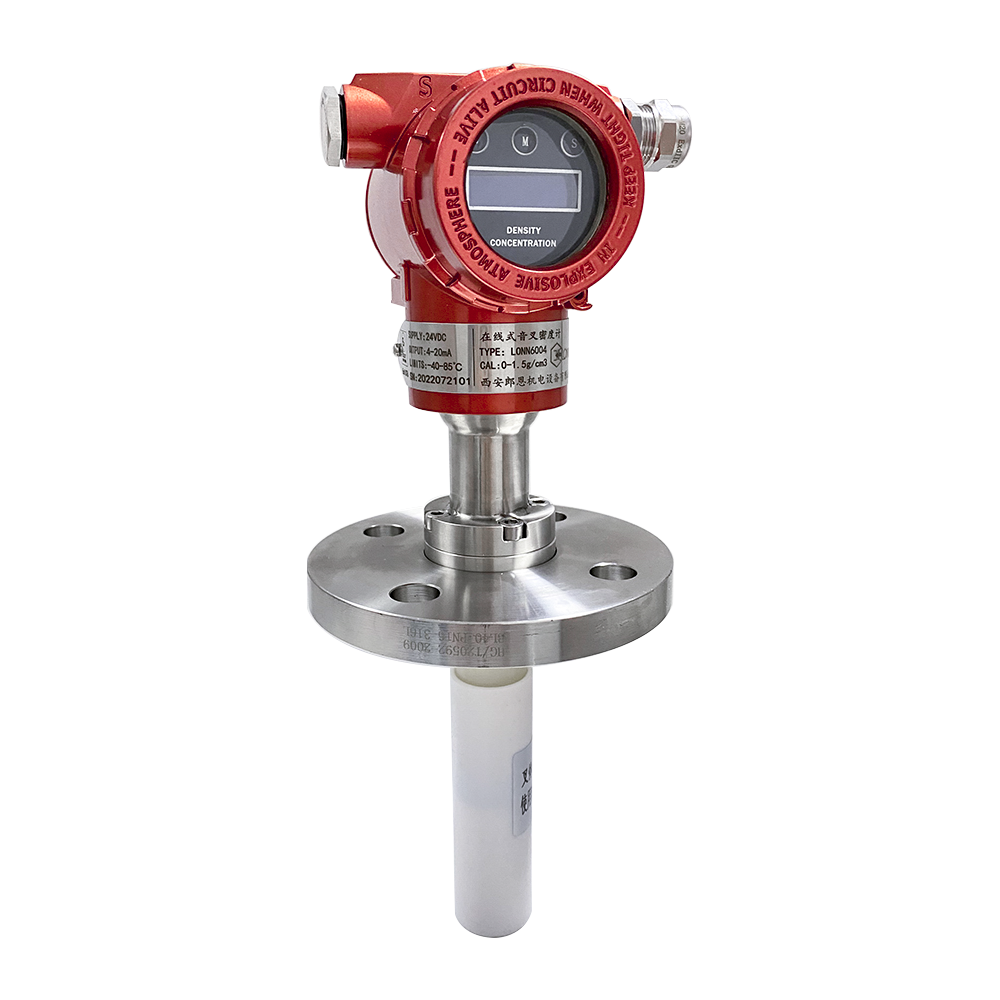
Entrained air is the enemy here. A bubble clinging to a fork lowers apparent density and prints a Brix value that is simply incorrect. Mount where the line runs full and the flow is representative, downstream of pumps rather than in a suction leg. One more difference from optics: a density meter weighs everything in the liquid, suspended solids included, so a pulp-heavy juice requires its own correlation.
Where the conversion table comes from
Two curves have to be right. The first maps the measured property to density or nD. The second maps that property to °Bx at the measured temperature, and this is where most specifications silently go wrong. ICUMSA tables describe pure sucrose in water. High-fructose corn syrup, honey, malt wort and tomato serum each reside on a different curve, so a factory sucrose table loaded into a transmitter will display a plausible quantity that does not match a laboratory Brix on those products.
Temperature compensation deserves the same skepticism. A single coefficient held across 0–70 °Bx and 20–90 °C cannot reproduce a two-dimensional matrix. Ask to see the compensation grid. Validate that the temperature sensor resides at the measuring element, not metres away in a cooler run of pipe. These are datasheet queries; published accuracy figures assume them.
Two routes, compared
Choosing between optics and density is less about accuracy than about what else is in the pipe.
The concentrate that read two degrees low
A fruit concentrate line held a 65 °Bx endpoint by grab samples and a bench refractometer, and batches swung either side of target. An inline unit went in at the evaporator discharge; for the first week its reading sat about two degrees below the lab. Nothing was wrong with the optics. The tapping point sat beside a dead leg near the vacuum vessel, where flash vapour left a fine stream of bubbles and a sugar film built on the prism between CIP cycles. Moving the sensor to the pump discharge, adding a scheduled prism flush, and checking zero on water each week brought the two numbers into line. Endpoint variability fell with them. The instrument had been measuring the dead leg faithfully the whole time.

Episodes like that are why installation drawings get reviewed before purchase orders. A specification that lists accuracy but says nothing about mounting, cleaning, or the reference approach has not specified inline brix measurement at all.
What breaks the reading
None is a sensor fault. Each is a reason inline brix measurement should be commissioned as a practice — sampling point, cleaning regime, curve, reference check — rather than delivered as a box.
Specifying the measurement
Get the curve and the temperature grid right, keep the prism spotless, and check against the lab on a schedule. That is most of the effort. The rest is wiring the output to the valve that actually controls the evaporator.