
A distillery and a biofuel refinery measure the same quantity for opposite reasons. The distiller is chasing a flavor boundary that moves with the alcohol strength; the refiner is chasing a fuel specification that moves with the water left behind. Both reduce to one number: how much ethanol is genuinely in the stream. Ethanol concentration measurement is the step that converts a density reading into that number — ABV on the still, proof on the label, blend ratio at the tank. The sensor itself is the easy part. The conversion curve, the temperature correction, and the moment of the cut are where the value is won or lost, and a reading that describes yesterday's sample instead of today's flow is worse than none at all.

Two industries, one measurement problem

Distillers and biofuel producers rarely talk to each other, yet they fight the same physics. On a spirit line, the ethanol percentage sets where the cut falls between heads, hearts, and tails — the difference between a saleable product and a re-distillation load. The number also carries fiscal weight: tax and label declarations are tied to declared strength, so the reading has to survive an audit, not just a shift handover. A biofuel plant cares about the same ethanol fraction but at the other end of the range, tracking fermentation progress at a few percent ABV and then confirming the dehydration column has pushed the product past 99.5% vol before it becomes compliant motor fuel. Both duties live or die on continuous ethanol concentration measurement at the process point, not on a bench result that arrives hours late.

Both fail identically — the spirit still loses its cut window to a late grab sample, and the biofuel line ships off-spec blend before the lab calls. A strength known only after the fact is a strength you cannot act on.

Density already knows the answer

There is no probe that counts ethanol molecules directly. What plants measure is density, and then they let the ethanol–water relationship do the rest. At 20 °C the density of a plain ethanol–water mix falls smoothly from about 0.9982 g/mL at 0% ABV to about 0.7892 g/mL at absolute ethanol, but it does not fall in a straight line — mixing the two liquids contracts the volume, so 50 mL of each gives roughly 96.5 mL, not 100. That curvature is why the official tables, not a rule of thumb, have to drive the conversion. Mixing arithmetic should therefore track mass fractions rather than a naive volume sum — the contraction is already baked into the official tables.

For reference, the international alcoholometric tables (OIML R 22, also used by AOAC and IUPAC) give, at 20 °C, approximately:
ABV (% vol)Density (g/mL, 20 °C)
0 (water)0.9982
100.9847
200.9736
400.9481
500.9301
600.9091
800.8593
950.8114
100 (absolute)0.7892

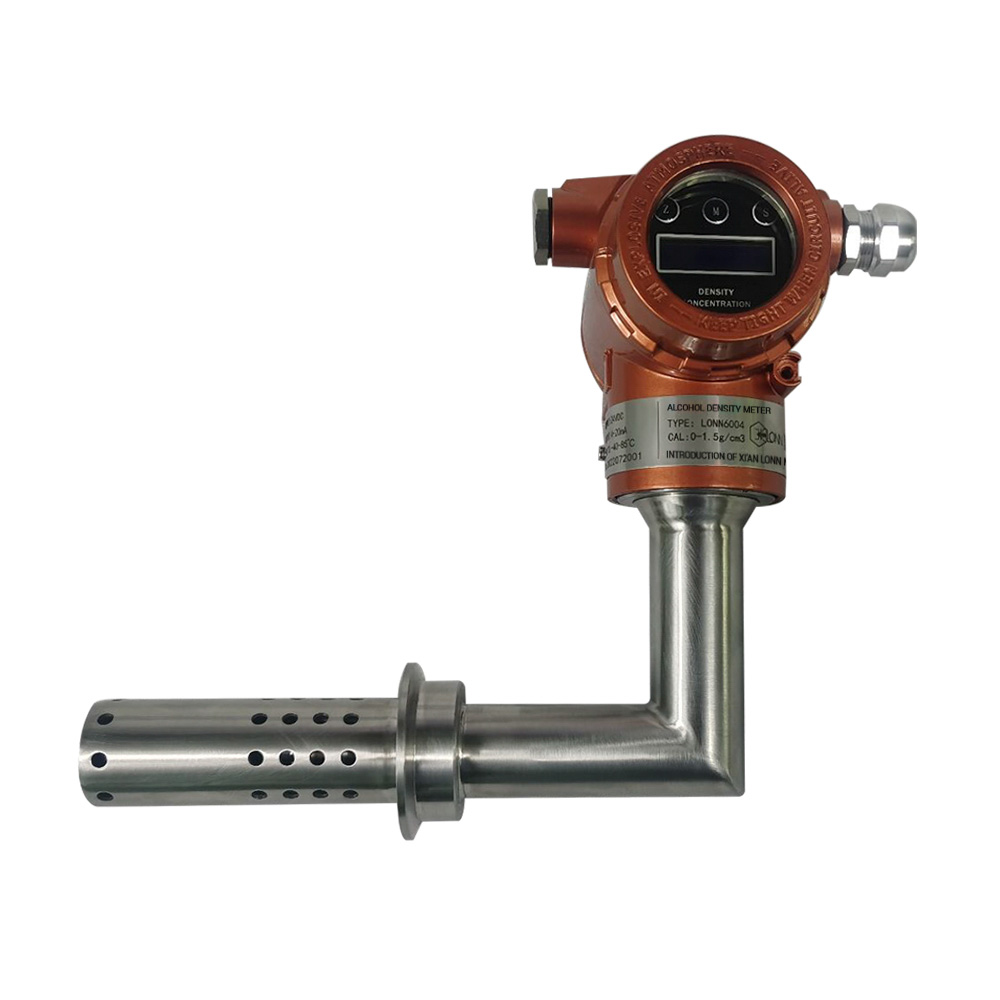
A tuning-fork density meter reads that density continuously, and with the alcohol table and temperature correction loaded it outputs ABV, proof, or specific gravity live. The underlying principle is covered by ISO 15212 for vibrating-element meters and ASTM D4052 for digital density measurement; the density-to-strength conversion itself rests on the OIML/AOAC alcohol tables. The density measurement hub collects the technology pages behind this, and ethanol concentration measurement by density is simply that relationship applied to a flammable, volatile stream.

alcohol density concentration meter2

Why the bench hydrometer loses on a running still

The bench hydrometer is accurate and cheap, and it is the wrong apparatus for a running still. The transition from heads to hearts to tails is a narrow window of a few minutes, and the alcohol strength is swinging fast right there. By the time an operator draws a sample, walks it to the bench, waits for temperature equilibrium, and reads it, the cut has moved — so the decision is made on a number that no longer describes the line. The result is hearts cut short, or tails drawn into the heart, which costs both yield and character.

It is also the dangerous tool for the job. Ethanol vapor is flammable, with a flash point near 13 °C, so the condenser outlet and collection area are hazardous zones where manual sampling is exactly what you want to minimize. A representative single point also misses the transient swings that decide quality. The inline density measurement methods guide explains why moving the measurement to the pipe, rather than the bottle, is the structural fix, and the non-nuclear density measurement for chemical industry note covers why plants keep radiometrics out of this service. That is the core reason ethanol concentration measurement on a running still belongs in the pipe, rather than the bottle.

Inline, reading ABV where the cut happens

Placing the sensor at the condenser outlet, on the fermenter, at the dehydration column, or on the blend and fill line turns ethanol concentration measurement from a post-mortem into a control input. On a pot or column still, a density meter just after the condenser reads the evolving ABV continuously; set an ABV threshold and the receiving vessel switches automatically between heads, hearts, and tails. On a fermenter, the falling specific gravity tracks fermentation to completion and calculates final ABV without a hydrometer draw. On a biofuel dehydration column, the same principle confirms the overhead product has crossed the 99.5% vol fuel threshold.

The output is the point: 4–20 mA plus RS-485 Modbus drops straight into the DCS or PLC, so the cut point or the blend ratio is actuated from the live reading. A Coriolis density meter does the same job and adds mass flow on the same device, which matters when you also need dosing totals. When both density and flow are on the table, the inline versus Coriolis comparison lets you avoid paying for mass flow you will not use.

The temperature trap bites harder for ethanol

Ethanol expands with heat roughly four times faster than water near room temperature — pure ethanol loses about 0.00085 g/mL per degree Celsius. Because the density-to-ABV link is steep, a few degrees of uncorrected temperature can move the strength reading by more than a percent, which is the entire tolerance on a fiscal cut. Distillation condenser outlets run 20–40 °C and biofuel processing can reach 80–90 °C, so the correction is not a refinement, it is the measurement. This is exactly where ethanol concentration measurement is won or lost — at the temperature correction, not the probe.

Field caution. The temperature correction must sit on a sensor at the density point, not on a transmitter metres away where the fluid is at a different temperature. Use the full ethanol–water density–temperature table for your ABV range, not a linear approximation. Exact coefficients for your mixture should be confirmed against the device datasheet and the official alcohol table.

Spirits and biofuel are not the same duty

Treating every alcohol application as one spec is the mistake that gets instruments returned. Spirits work spans a wide range — you need resolution through the 0–80% ABV cut region — while biofuel spans from a few percent in fermentation up to anhydrous product, and the dehydration purity check is unforgiving. Both sit in hazardous areas because ethanol vapor is present, so explosion protection is not optional: an Ex d IIC T6 housing certified to ATEX, IECEx, or CNEX is the baseline for Zone 1 and Zone 2, not a premium option.

Accuracy expectations diverge too. Fiscal and label-declaration duties demand the ±0.1% ABV class that OIML-recognized digital density meters deliver; a process-monitoring loop can relax that. Hygiene differs as well — food- and beverage-grade service calls for 316L wetted parts and tri-clamp connections and survives CIP cycles, whereas an industrial biofuel line may tolerate a hardier industrial fit. 316L is the standard for clean alcohol; if your stream carries aggressive additives, confirm the wetted material against the actual chemistry, as the density meter selection guide lays out. For the hardware itself, inline concentration meters built on these principles are the usual starting point. For both spirits and biofuel, ethanol concentration measurement has to satisfy three constraints at once — range, hazard, and hygiene — and a sensor that clears one can still fail the others.

A field note: the missed hearts cut

One distillery I recall ran its cuts on a manual alcoholmeter at the condenser. The outlet temperature swung with the run, the sample took minutes to read, and the hearts window was judged by feel as much as by number. Across a season they were consistently leaving hearts in the tails and pulling tails into the hearts — lost yield and a volatile flavor profile batch to batch. Fitting an inline density meter at the condenser outlet and driving the receiving-vessel switch from a fixed ABV threshold removed the guess. The hearts cut landed in the same place every run, and the off-grade volume dropped. The unit did not invent anything; it just measured ethanol concentration measurement at the moment the decision had to be made, instead of ten minutes after it.
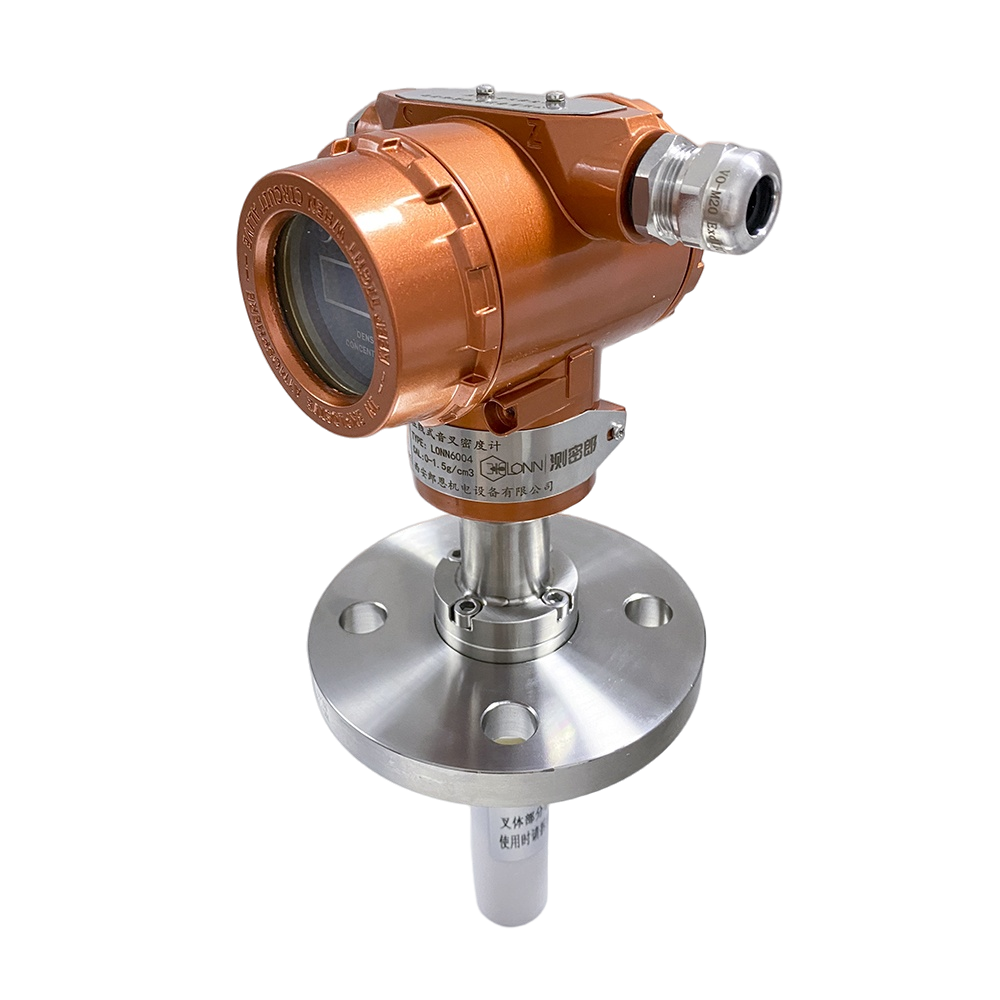
Ceramic Tuning Fork Density Meter2

Mistakes that quietly wreck ethanol readings

Most ethanol measurement failures are calibration and installation failures wearing a sensor's name.

  • Temperature left uncorrected, or corrected with the wrong sensor. A reading taken ten degrees from the reference condition carries a strength error larger than the sensor’s own uncertainty. Correct at the density point.
  • One alcohol table for every product. The OIML curve describes plain ethanol–water. Liqueurs, wines, and flavored spirits carry sugar and extract that add mass the table never counted, so a direct density reading reads low on strength. Official methods distill the sample to strip extract first, then measure — the obscuration correction is not optional for those drinks.
  • Skipping explosion protection in a vapor area. Ethanol’s flash point near 13 °C makes the still and blend areas hazardous. A non-certified instrument there is a compliance and safety failure, not a cost saving.
  • Sampling where the flow stagnates. A tap beside a dead leg or above a gas-entraining point gives you foam and bubbles, not ABV. Mount in representative flow.
  • Using refractometry or conductivity as the fiscal number. Refractometers are disturbed by dissolved sugar and extract; conductivity sees ions, not ethanol. Both are useful trend tools, neither is a strength declaration.
  • Forgetting the volume contraction. Converting between mass and volume percentages without the contraction term quietly moves the answer; quote the basis (ABV, % w/w, or proof) every time.

None of these is a hardware fault. They are all reasons ethanol concentration measurement has to be specified and installed with discipline, then checked against the official alcohol table.

A short selection checklist

Before specifying ethanol concentration measurement for a spirit or biofuel line, answer four questions:

  1. What range and accuracy do you actually need? A cut-resolution duty and a dehydration-purity duty are different instruments, and a fiscal declaration demands a higher class than a process trend.
  2. What are the temperature, pressure, and hazard conditions? Hot, pressurized, and vapor-prone streams push you toward a temperature-compensated, explosion-protected density element with the right process connection.
  3. Continuous or spot-check? If the strength swings between visits, an inline density or Coriolis meter earns its place; if the stream is stable and rarely touched, periodic checks may suffice.
  4. Do you also need flow or mass total? If only concentration, the selection guide steers you to a probe; if you also totalize, a Coriolis meter does both.

Answering those four questions is how a sound spec gets written instead of guessed. From there, the concentration measurement cluster and our application engineers can match the method to your ethanol type, ABV range, and duty.

Frequently asked questions

What is the most accurate method for ethanol concentration measurement?

For official ethanol concentration measurement on a plain ethanol–water stream, a temperature-compensated vibrating-density or Coriolis meter holds strength within roughly ±0.1% ABV and is recognized by OIML, AOAC, and IUPAC for official alcohol determination. Accuracy depends as much on the loaded alcohol table and its temperature correction as on the sensor. For drinks with sugar or extract, a distillation step to remove the extract precedes the density measurement, because the extract otherwise depresses the apparent strength.

Can a hydrometer measure ABV inline?

No. A hydrometer is a bench instrument that needs a still sample at a known temperature. It cannot read the moving line, and on a running still the cut window passes before the reading is ready. Inline ethanol concentration measurement uses a density meter at the process point to output ABV continuously, which is what makes automatic cut control possible.

Why does temperature affect ethanol readings so much?

Ethanol expands with heat about four times faster than water, roughly 0.00085 g/mL per degree Celsius for pure ethanol and a comparable rate across the mix. Because density-to-ABV is steep, a few uncorrected degrees shift the strength by more than a percent. The correction must use the full ethanol–water density–temperature table at the measured temperature, not a single reference point.

What ethanol concentration does biofuel blending need?

Fuel ethanol is typically dehydrated to at least 99.5% vol before blending, and finished blends such as E10 or E85 are verified against specifications like ASTM D4806. Ethanol concentration measurement therefore spans two very different ranges on a biofuel site: a few percent ABV in fermentation, and anhydrous purity at the dehydration column outlet. Both are monitored inline rather than by lab sample.

Do I need explosion protection for alcohol concentration meters?

Yes, in almost every distillery and biofuel installation. Ethanol vapor is flammable with a flash point near 13 °C, so the still, blend, and fill areas are hazardous zones. The instrument should carry Ex d IIC T6 certification to ATEX, IECEx, or CNEX standards for Zone 1 and Zone 2 service; this is a baseline safety requirement, not an upgrade.

About LONNMETER GROUP. We design, manufacture, and support inline density and concentration instrumentation for distillery, brewery, biofuel, and pharmaceutical alcohol service. Our tuning-fork and Coriolis density meters are widely used as inline ethanol concentration analyzers on fermentation, distillation, and dehydration duties. This guide is informational and does not replace the procedure supplied with your instrument; reference values such as the ethanol–water density relationship, temperature coefficients, explosion-protection ratings, and wetted-material limits should always be confirmed against the device datasheet, the official OIML/AOAC alcohol tables, and your local fuel or beverage specification. The measurement methods referenced here rest on ISO 15212 (vibrating density meters), ASTM D4052 (digital density measurement), and the OIML R 22 / AOAC / IUPAC alcoholometric tables.

Explore the concentration measurement cluster or talk to our application engineers about a method matched to your ethanol type, ABV range, and duty.

Leave a Reply

Your email address will not be published. Required fields are marked *

Request for Quotation

Please provide your application parameters for a technical assessment and formal quote.