A battery plant we worked with filled its formation line by hand. An operator drew a hydrometer sample from every fifth cell, squinted at the float, wrote the number in a book, and moved on. The cells that left the line looked identical. The ones that came back under warranty did not. When we mapped the returns against the handwritten log, the pattern was obvious: the off-spec cells were the ones filled when the electrolyte tank had drifted, and nobody had noticed because the tank was checked once a shift, not continuously. That gap — between a number taken by hand every few cells and the actual density moving through the line — is the whole reason battery electrolyte density monitoring belongs inline, not in a glass tube.

This article compares the inline methods that actually fit a battery electrolyte duty: tuning-fork, clamp-on ultrasonic, and Coriolis. It also says where a manual hydrometer still earns its place, and where it quietly costs you consistency.

Why battery plants watch electrolyte density

In a flooded or stationary lead-acid battery, the electrolyte is dilute sulfuric acid, and its density tracks the state of charge almost linearly. A fully charged cell sits near 1.280 g/cm³; a discharged one drops toward 1.120 g/cm³. That single number tells you four different things a plant cares about:

  • State of charge. For flooded lead-acid, density is still the cheapest, most direct SoC indicator there is. Voltage alone lies when surface charge is present; density does not.
  • Formation quality. During formation the plates convert, and the acid concentration swings hard. Catching a cell that did not form correctly before it is sealed saves a return, not a rework.
  • Fill consistency. Every cell in a string must leave the fill station at the same density, or the string ages unevenly. Hand sampling every fifth cell leaves the other four unchecked.
  • Make-up and blend control. The acid itself is mixed and diluted on site. The tank that feeds the line has to stay in spec, and a tank does not announce when it drifts.

The pain point is not that plants do not measure. It is that they measure the wrong thing at the wrong time — a snapshot instead of a stream. Battery electrolyte density monitoring is what closes that gap, and the rest of this article is about how to do it without turning the line into a service call.

What the fluid actually is

Be honest about the liquid before you pick a sensor, because battery electrolyte is a demanding one. It is conductive (so some sensor electronics dislike being near it), corrosive (so wetted materials matter), and it sits in a narrow, well-known density band of roughly 1.10 to 1.30 g/cm³ across the charge cycle.

One scope note, stated plainly: this article is about flooded and stationary lead-acid batteries and the acid make-up stage, where a liquid electrolyte genuinely exists and its density is meaningful. Sealed lithium-ion cells carry their electrolyte in a gel or polymer and are not monitored this way — do not let a vendor sell you an inline density cell for a chemistry that has no free liquid to measure. Good battery electrolyte density monitoring starts with admitting which chemistry you are actually running.

The methods, compared

Three inline techniques fit a battery acid duty, plus the hand hydrometer they replace. Battery electrolyte density monitoring lives or dies on which of these you put in the line, so weigh them on the fluid and the pipe rather than the price tag.

Manual hydrometer — the baseline, not the goal

The glass hydrometer is cheap, familiar, and wrong for continuous control. It samples one cell at a time, exposes the operator to acid, and produces a number that depends on how straight they held the tube and what the temperature was. For commissioning a single stationary bank it is fine. For a production or formation line it is a stopwatch in a race, and battery electrolyte density monitoring is the upgrade that retires it from daily duty.

Tuning-fork inline — the workhorse for conductive, corrosive acid

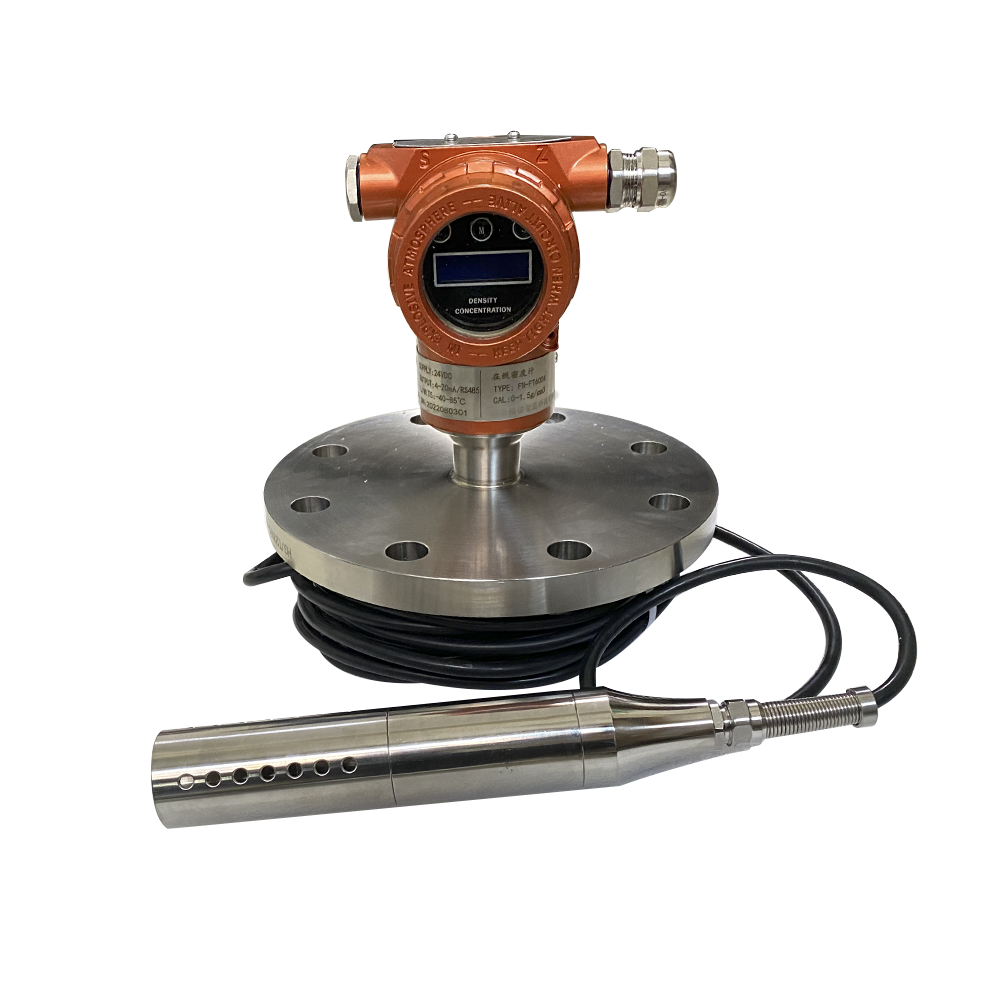
A tuning-fork density cell measures by vibrating a slender fork in the liquid; denser acid pulls the resonant frequency down, and the instrument turns that into density without touching the chemistry. Because the only wetted part is the fork itself, you specify it in a material that shrugs off sulfuric acid — Hastelloy, or a ceramic-coated element — and the rest of the body stays out of the danger.

For battery electrolyte density monitoring this is the option we reach for most often: it is continuous, compact, tolerant of the bubbles and flow disturbance you get on a fill line, and it reads the 1.10–1.30 band with the margin the process needs. When battery electrolyte density monitoring has to survive acid for years rather than months, the fork material is the decision that matters more than the electronics. Our tuning-fork density meter explainer walks through the physics; on the LONN-700C family accuracy runs ±0.002 g/cm³ per the LONN-700CM manual, far tighter than a hydrometer reading you trust at ±0.005.

Clamp-on ultrasonic — no wetted part at all

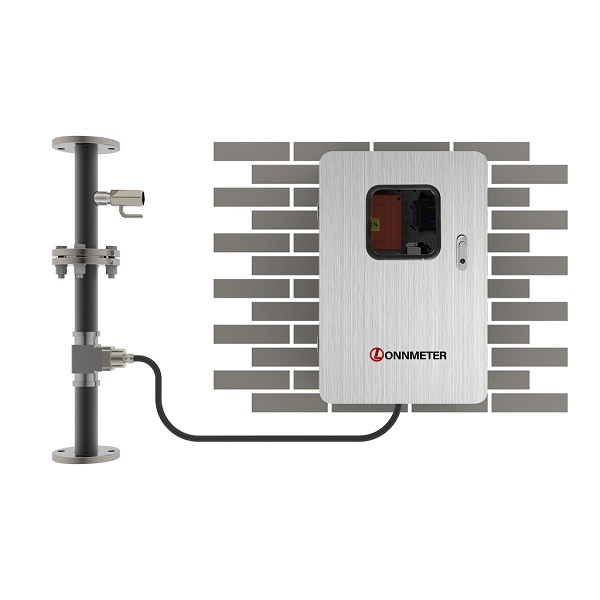
Clamp-on ultrasonic infers density from the speed of sound through the acid, and it does it from the outside of the pipe. Nothing touches the product, which removes the corrosion question entirely and makes it the right call on lines you cannot cut or would rather not open. It also tracks concentration at the same time, which is useful when you are controlling the blend tank rather than the cell.

The trade is discipline: the pipe wall must be clean and the coupling sound, and scale or air on the inner wall will lie to you. On a clean, well-run transfer line it is excellent; on a neglected one it is a complaint waiting to happen. For battery electrolyte density monitoring on a pipe you cannot cut, that discipline is a small price for zero wetted parts. Our ultrasonic density meter article covers the LONN7000 family, which carries dual 4–20 mA outputs, RS485, and IP65 hardware built for damp, acidic locations.

Coriolis — the accurate one that also weighs the flow

A Coriolis meter reads density as a by-product of measuring mass flow, so if you are already buying one to meter the acid into the cell, the density comes free and extremely accurate. For pure density duty it is the most expensive of the three and the most intrusive to install, but on a high-value line where every gram matters it earns its place. Our Coriolis density meter piece covers the trade in detail.

How to choose the method

When the choice is genuinely close, our density meter selection guide gives a structured way to decide. For battery electrolyte density monitoring the short version is:

  • Can you cut the pipe and want the cheapest continuous reading? Tuning fork. It handles the conductive, corrosive acid natively and asks for little.
  • Can you not cut the pipe, or do you want zero wetted parts? Clamp-on ultrasonic, provided the line is clean.
  • Are you already metering the acid and want the best number? Coriolis.
  • Is this a one-off commissioning of a stationary bank? A hydrometer still does the job; just log the temperature.

Pick on the duty and the pipe, not on which brochure you read last. The right battery electrolyte density monitoring choice is the one that matches your chemistry, your line, and the number you actually need to act on.

battery electrolyte density monitoring

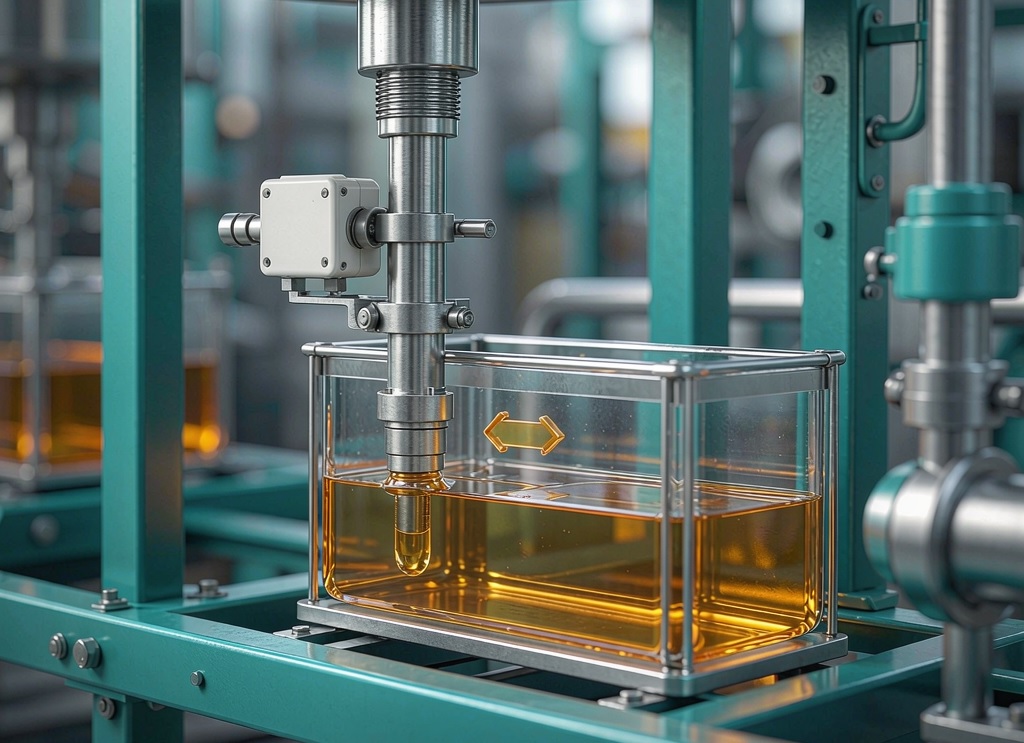
Fig. 1 — The line that should be measured, not the cell that got sampled. An inline density sensor on the acid transfer pipe watches every fill, not every fifth one.

Installation notes that matter for acid

Battery electrolyte density monitoring has a few failure modes that are specific to acid, and treating them as afterthoughts is how a good sensor becomes a spare part. They are worth calling out before steel goes in the line.

  • Specify the wetted material. On a tuning fork, the fork and any seal must survive dilute sulfuric acid for years, not months. Hastelloy or a ceramic coating is not optional here.
  • Put the sensor after the blend, not before. The acid is mixed on site; a reading taken in the unmixed layer is a reading of nothing useful. Downstream of where the tank actually finishes blending, or downstream of the fill manifold, is where the number means something.
  • Temperature-compensate, always. Density and temperature move together, and acid moves a lot. A density value with no product temperature attached is half a measurement — and on a fill line where the acid warms as it pumps, it is a misleading half.
  • Mind the leak path. Acid finds the weak gasket. A hygienic clamp or a flanged connection done properly is cheaper than the cleanup and the incident report.
  • Ground the signal at one end. Same rule as any inline density loop: shield to one end only, or you build a ground loop that breathes with the plant load and looks like process noise.

If you have not yet fixed the measurement technology, our inline measurement methods guide lays out the main techniques before you commit. Read that first if you are still deciding.

The mistakes that cost consistency

Every battery electrolyte density monitoring project we revisit shows the same handful of errors:

  1. Hand sampling on a production line. The line runs thousands of cells; the log covers a few. The drift happens between the samples.
  2. No temperature compensation. The number looks wrong in the afternoon because the acid warmed, not because the cell is bad.
  3. Wrong wetted material. A fork spec’d for water chemistry etches and drifts inside a season.
  4. Measuring before the blend settles. The tank reads homogeneous on paper and stratified in reality.
  5. Ignoring conductivity near the sensor. On some designs a conductive, acidic film on the body can couple into the signal; material and grounding choices decide whether that bites you.

None of these is a sensor fault. All of them are decisions made — or skipped — at the design stage.

tuning fork density meter

Fig. 2 — Tuning-fork density transmitter . Slender wetted fork, compact body; specify in Hastelloy or ceramic to survive battery acid. Accuracy ±0.002 g/cm³ on the LONN-700C family per the LONN-700CM manual.

ultrasonic system

Fig. 3 — Ultrasonic density system (LONN7000 family, site photo). Clamp-on or flush acoustic path, zero wetted parts, dual 4–20 mA plus RS485, IP65 for damp, acidic duty.

Why the group behind the instrument matters here

Readers of this blog know us as an instrument maker, and that is true, but it is only part of the picture. LONNMETER designs the fork sensor, machines the bodies, winds and calibrates the electronics, and builds the washdown ultrasonic systems in our own facilities — then fields application engineers who spend their weeks inside process plants rather than showrooms. Design, R&D, production, and solution delivery sit under one roof, so the person who recommends your wetted material can walk twenty meters and ask the calibration technician a question. On a corrosive, conductive duty like battery acid, that short distance between “the manual says” and “your line will do” is the difference between a sensor that lasts and one that becomes a spare part.

If you are scoping acid make-up or a formation line and would rather not guess at the wetted material or the sample point, tell us the chemistry, the pipe size, and the duty — the conversation is faster when it starts from your actual line. Our general density measurement hub collects the rest of the technical guides if you would rather read first and call later. For the acid side specifically, our non-nuclear density measurement piece for the chemical industry covers corrosive-stream handling in more depth.

Frequently asked questions

Can you monitor battery electrolyte density inline on lithium-ion cells?

No — not the finished cell. Sealed lithium-ion carries its electrolyte in a gel or polymer with no free liquid to measure, so density monitoring does not apply. This method fits flooded and stationary lead-acid batteries and the sulfuric-acid make-up stage, where a liquid electrolyte genuinely exists and its density tracks state of charge.

What density range does lead-acid electrolyte cover?

Roughly 1.10 g/cm³ when discharged up to about 1.28 g/cm³ when fully charged, with small climate corrections. The band is narrow and well known, which is exactly why an inline sensor with ±0.002 g/cm³ accuracy catches drift a hydrometer misses.

Is clamp-on ultrasonic better than a tuning fork for battery acid?

Neither is universally better. Clamp-on wins when you cannot cut the pipe or want zero wetted parts; a tuning fork wins on cost and tolerance of disturbed, bubbly fill lines, provided the fork is specified in Hastelloy or ceramic to survive the acid.

Do I need temperature compensation for electrolyte density?

Yes. Density and temperature move together and acid moves a lot, so a reading with no product temperature attached is misleading. Log density with the product temperature, or the afternoon warm-up will look like a bad cell.

How is inline monitoring different from a hydrometer?

A hydrometer samples one cell by hand and depends on the operator and the temperature; an inline cell watches every fill continuously and feeds the number to the PLC with a timestamp. For a production or formation line, the difference is consistency, not just convenience.

Which inline method should a battery plant start with?

For most flooded lead-acid fill and formation lines, a tuning-fork cell in acid-rated material is the pragmatic first step: continuous, compact, and native to conductive corrosive acid. Choose clamp-on ultrasonic if the pipe cannot be cut, and Coriolis if you are already metering the acid and want the tightest number.

Leave a Reply

Your email address will not be published. Required fields are marked *