
A differential pressure density meter is the oldest continuous density method still on plants, and also the most misunderstood. It does not vibrate, it does not radiate, and it has no part moving in the stream. It simply reads the weight of a known column of liquid and turns that weight into density. For the right duty — thick slurries, viscous liquors, two-phase streams — it outlasts instruments that are far more elegant on paper. For the wrong one, it quietly lies because the column it trusts is not as fixed as the maths assumes.
The equation that does all the work
The whole instrument rests on one line of hydrostatics:
ρ = ΔP / (g × H)
Pressure difference between two points, divided by gravity and the vertical distance between them, gives density. If the height H is fixed and known, and you measure the pressure drop ΔP with a differential pressure transmitter, the rest is arithmetic. No resonant frequency to track, no sound path to keep clear, no source to license.
That simplicity is the appeal and the trap. The meter is only as good as its belief that H — the distance between the two taps — is exactly what the drawing says, and that the liquid between them is the liquid you think it is. Disturb either and the number drifts without the transmitter ever failing.
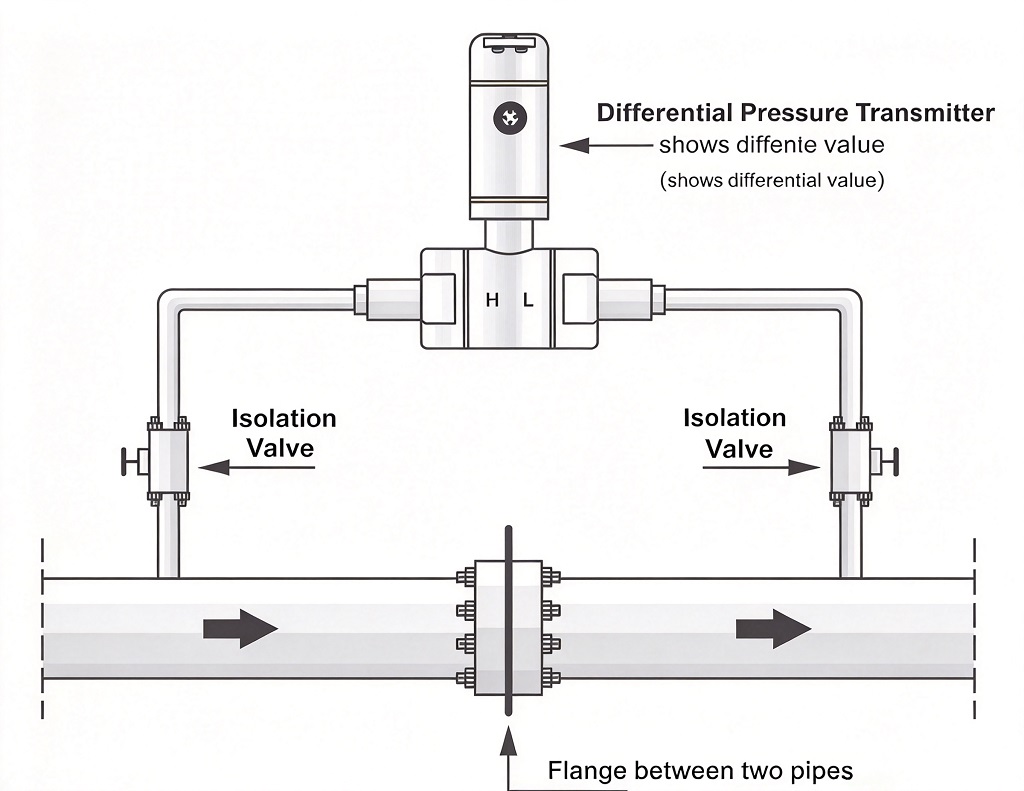
What the instrument actually is
A practical differential pressure density meter is two flush-mounted diaphragm seals set a known vertical distance apart on the same process connection, linked by oil-filled capillaries to one DP transmitter. The diaphragms sense only pressure; they do not touch flow, viscosity, or entrained gas the way a vibrating element does. Because the sensing surface is flush, solids that would coat a tuning fork slide past, and there is no small bore for slurry to bridge.
The transmitter does the rest: it reads ΔP, applies its own temperature correction from a Pt100 at the sensor, and outputs density, concentration, or a derived unit on 4–20 mA or a digital bus. There is no moving part in the wetted path, which is why the method survives abrasive and scaling services that chew through more delicate cells.
Where DP density quietly wins
The differential pressure density meter earns its place in three situations where resonant and acoustic methods struggle:
The catch: it measures a column, not a point
A resonant meter measures the fluid at the element. A differential pressure density meter measures the average density of the entire column between the two taps. If that column height is not what the calculation assumes — because the pipe is not truly vertical, because level in a vessel swings, because the lower tap sits in a different regime than the upper one — the error lands straight in the density value.
One more property worth knowing: because density maps to concentration for a given fluid, most DP density transmitters output percent concentration or °Brix directly through a stored correlation. The same hydrostatic reading that gives you density also gives you the process variable the control system actually wants — provided the fluid composition is stable enough that the density-to-concentration model stays valid. That is a strength of the method, and a reminder that the model, not the transmitter, sets the concentration accuracy.
DP versus fork versus Coriolis — pick on the duty
Most enquiries resolve on one axis, and the differential pressure density meter belongs at one end of it.
Installation that makes or breaks it
A differential pressure density meter lives or dies on three installation rules:
