
The syrup batch was ready at 6:40 in the morning. The line stood idle until 7:25.
Forty-five minutes, gone, waiting on a lab technician to pull a sample, walk it to the bench, run it through a digital density meter at 20°C, and radio back a number. That number said 66.9 Brix. Spec said 66.0 to 67.0. Release. By then the evaporator upstream had drifted anyway, so the next kettle would need its own sample, its own wait, its own verdict.
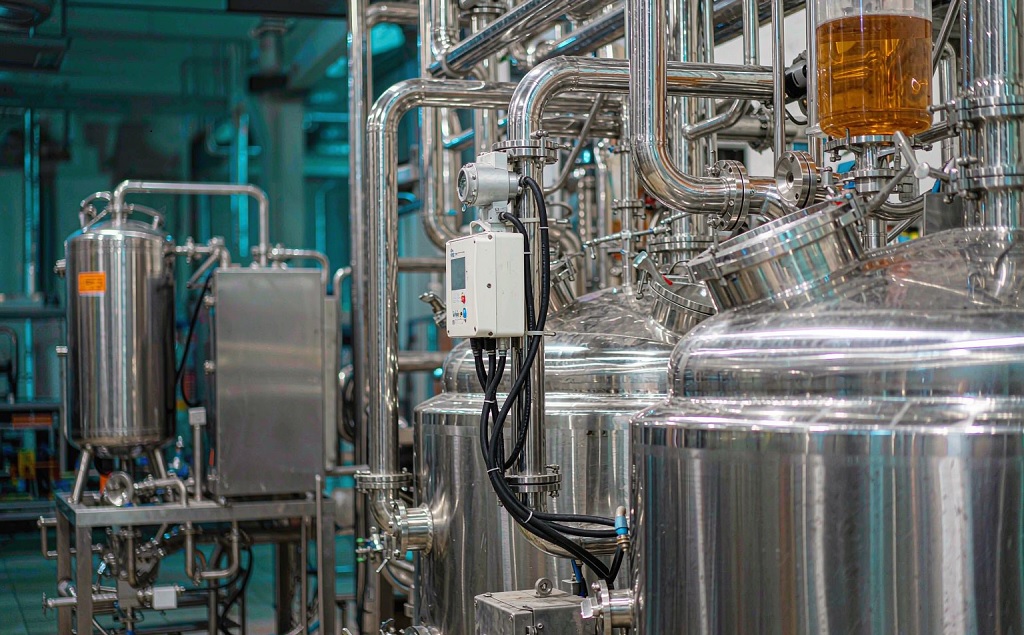
Multiply that by four production lines and two shifts. Now you begin to see why plants keep asking us the same question — can the measurement come to the pipe, instead of the pipe coming to the lab? The short answer is yes. Food-grade density measurement is mature, affordable, and running in plants today, and our inline measurement methods guide collects the main techniques. The longer answer is the rest of this article, because food adds a layer of difficulty that chemical plants never have to think about: everything that touches product must survive inspection, survive cleaning chemicals, and survive an auditor with a clipboard.
Why food plants measure density at all
Sugar is the payload in most food and beverage processes, and food-grade density measurement is how that payload announces itself. Dissolve solids into water and the liquid gets heavier per liter — reliably, measurably, predictably. That single physical fact powers a surprising share of the plant:
A laboratory instrument answers these questions beautifully — our overview of inline versus laboratory density measurement covers that trade in detail. The problem in food is never accuracy at the bench. It is everything between the bench and the pipe.
The four hard parts of food-grade density measurement
Hard part one: hygiene is a design constraint, not a preference
In a chemical plant, a sensor is a sensor. In a food plant, every wetted surface carries a résumé that an inspector can demand to see. Product-contact materials need to be smooth, corrosion-resistant, and free of crevices where soil and microbes can shelter. Connections follow hygienic conventions — clamp fittings, welded bodies, polished stainless — because a threaded fitting hidden behind insulation is where an audit goes to die.
Cleaning is the second half of the constraint. Most food lines run CIP — clean-in-place — caustic and acid cycles pushed through the same pipe at 1.5 to 2.5 m/s, often above 70°C, followed by a final rinse. An inline sensor must endure those chemicals on its face, at those temperatures, on every cycle, for years. A sensor that measures beautifully but cannot take the wash is a spare part waiting to happen.
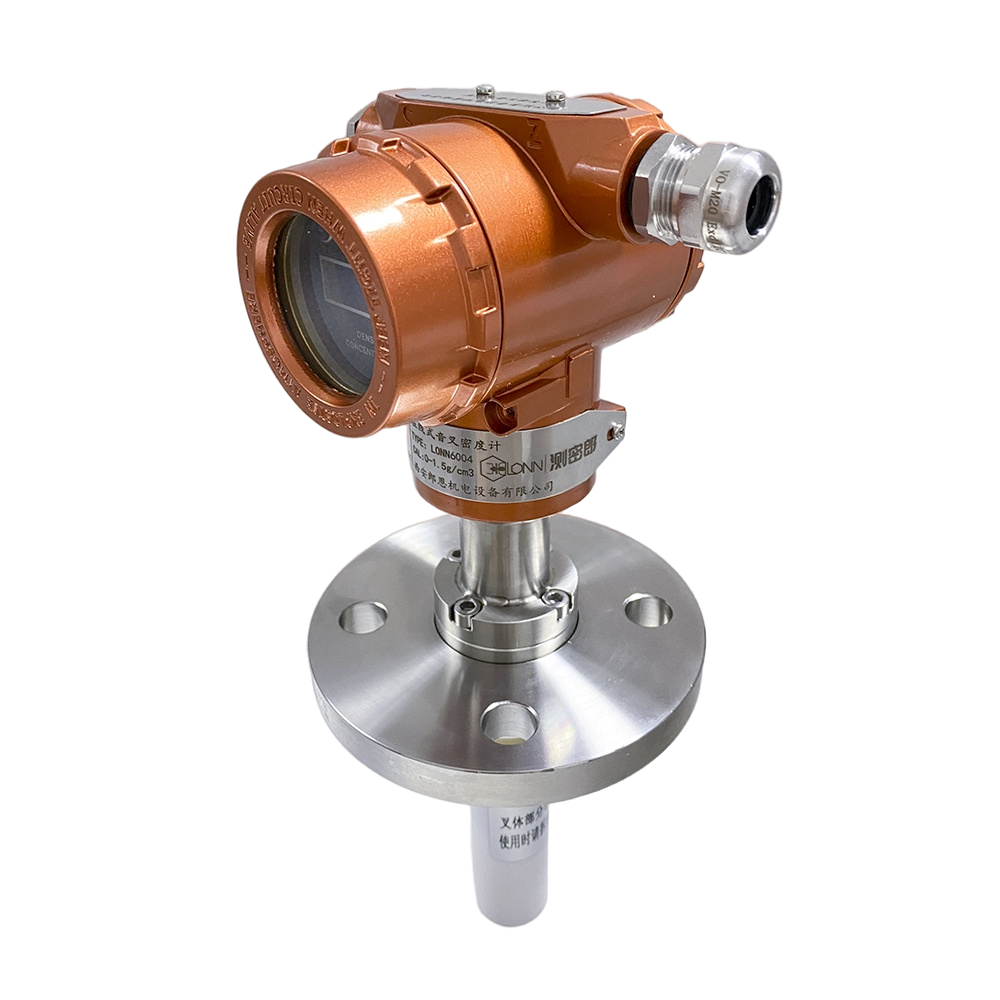
This is where material choice stops being academic — in food-grade density measurement it outweighs almost any line item on the datasheet. Our ceramic tuning-fork instruments exist largely for this reason: the wetted tine is a technical ceramic, inert to caustic and acid alike, with a stainless body and hygienic process connections. Where a metal tine would slowly dull or pit under aggressive wash chemistry, ceramic shrugs it off. It is the same logic that puts ceramic bearings in food pumps.
Hard part two: temperature moves the answer
Density depends on temperature. Strongly. A syrup that reads 1.327 g/cm³ at 20°C reads noticeably lower at 65°C straight off the pasteurizer, and the difference is pure physics — the sugar content never changed.
Every food-grade density measurement instrument fights back with internal temperature compensation, but the quality of that compensation separates a useful instrument from an expensive tube ornament. Ask any vendor how compensation behaves across your actual range, not just at reference conditions. Hot-fill lines, pasteurizer outlets, and anything downstream of a heat exchanger deserve a specific answer, in numbers, for your product matrix. We build compensation tables per product family for exactly this reason, and we put the drift budget in writing before the instrument ships.
Hard part three: one line, many products
A chemical plant runs a campaign. A food plant runs Tuesday's mango nectar, Wednesday's orange, and Thursday's seasonal limited edition — through the same pipe, the same filler, the same sensor.
Each product brings its own density-temperature curve, its own viscosity, sometimes its own entrained air. Food-grade density measurement on a mixed-SKU line is a switching problem as much as a sensing problem: the instrument and its compensation strategy must switch cleanly between products, and the plant's batch records must show which curve was active when. When we spec a food line, we ask for the full SKU list up front, including the ones marketing hasn't launched yet, because a sensor chosen against today's three products has a habit of failing quietly on product number seven.
Hard part four: compliance follows the number
Food plants live and die by traceability. Every batch record eventually meets an auditor, a customer audit, or — for alcohol — a tax authority. The density number in the record needs a defensible pedigree: calibrated against what, traceable to which standard, verified how often.
This is also where food-grade density measurement meets the radiation question. A nuclear density gauge, whatever its virtues elsewhere, imports licensing, security, and disposal obligations into a food plant, and QA managers want none of it. We wrote a full comparison of non-nuclear versus nuclear density measurement — the summary for food is that vibrational and ultrasonic technologies deliver the needed performance with zero radiological paperwork.
Choosing the inline technology for a food line
Two technologies cover the large majority of food-grade density measurement applications.
The tuning fork is a slender paddle that vibrates in the liquid; denser product drags the frequency down. It is compact, hygienic by design, tolerant of flow and bubbles, and accurate to the level food processes actually need. Our tuning-fork density meter explainer walks through the physics. Typical accuracy on our LONN-700C family runs ±0.002 g/cm³ with repeatability around ±0.0002, per the LONN-700CM manual — far tighter than any Brix spec requires, which is precisely the margin you want.
The ultrasonic method times a sound pulse through the product and infers density from acoustic velocity, alongside concentration capability. It suits lines where the sensor should sit flush with the pipe wall and where CIP velocity is punishing. Our ultrasonic density meter article covers the LONN7000 family, which carries dual 4–20 mA outputs and IP65 hardware built for washdown duty.
For completeness: Coriolis meters read density as a by-product of mass flow and excel where you are already buying one for the flow duty. If density is the only goal, a dedicated fork or ultrasonic cell usually wins on cost by a wide margin.
Installation details that decide the project
Most food-grade density measurement disappointments we visit trace back to the install, not the instrument. The short list we check on every food-site commissioning:
What the group behind the sensor changes
Readers of this blog know us as an instrument maker, and that is true, but it is only part of the picture. LONNMETER designs the fork sensor, machines the bodies, winds and calibrates the electronics, and builds the washdown ultrasonic systems in our own facilities — then fields application engineers who spend their weeks inside food plants rather than showrooms. Design, R&D, production, and solution delivery sit under one roof, so the person who specs your installation point can walk twenty meters and ask the calibration technician a question. That shortens the distance between "the datasheet says" and "your line will do."
For a concrete flavor of how this plays out, we documented a beverage-plant deployment end to end in our food-grade density case study — sampling points, commissioning checks, and the numbers the customer ultimately ran.
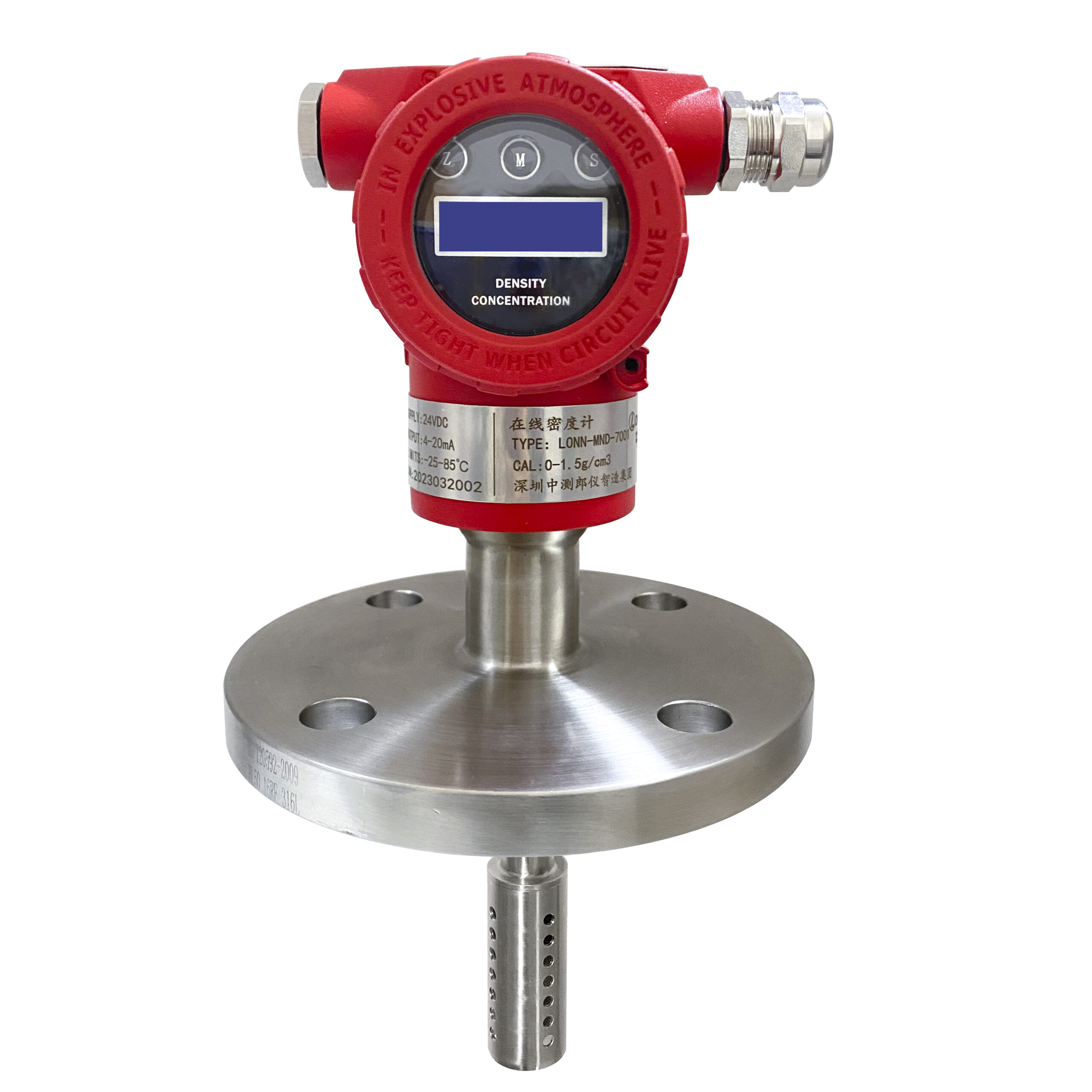
If you are weighing options for a specific line, tell us the product, the range, and the connection standard — the selection conversation is faster and more honest when it starts from your actual SKU list. Our general density measurement hub collects the rest of the technical guides if you would rather read first and call later.
Frequently asked questions
Can an inline density meter survive CIP cleaning cycles?
Yes, when it is specified for it. The wetted materials — 316L stainless, technical ceramic, and food-rated elastomers — must tolerate caustic and acid at cycle temperature, and the body must present no dead volume. Our ceramic tuning-fork instruments were developed with exactly this duty in mind, and we confirm chemical compatibility against your actual CIP recipe before shipment.
Which technology fits a beverage line better, tuning fork or ultrasonic?
For most syrup, juice, and blending duties, the tuning fork wins on accuracy margin, hygienic body design, and insensitivity to flow profile. Ultrasonic earns its place where flush mounting matters or where the same instrument should also track concentration. Both are non-nuclear and washdown-ready; the decision usually turns on connection style and the SKUs you intend to run.
How accurate does inline density need to be for Brix control?
A typical syrup or juice spec spans roughly ±0.5 Brix, which corresponds to about ±0.0025 g/cm³. An instrument accurate to ±0.002 g/cm³, such as our LONN-700C family, holds that spec with room to spare, so the limiting factor becomes installation and temperature compensation rather than sensor accuracy.
Do food plants need nuclear density meters?
Almost never. Vibrational and ultrasonic inline instruments cover food-grade density measurement without licensing, source security, or end-of-life disposal obligations. We reserve nuclear technology for duties it genuinely fits, and a food plant is not one of them.
How is temperature compensation handled for hot-fill products?
The sensor measures product temperature continuously and applies a product-specific compensation curve chosen for your recipe set. The curve is validated against grab samples across your real temperature band during commissioning, and switching between SKUs switches the curve — which is why we ask for the full product list before we quote.
Can inline density replace lab sampling for batch release?
It can, and plants that make the change rarely look back — release decisions move from a 45-minute loop to a number on the HMI. The responsible path is a parallel-run period: lab results and inline readings logged side by side for a defined batch count, a written agreement criterion, and only then a switch of authority. Auditors respect that story precisely because it is boring.
The bottom line
Food-grade density measurement is not a harder version of the chemical problem — it is a different problem wearing a white coat. Hygiene, temperature, product churn, and auditability reshape every decision, from wetted material to signal wiring. The instruments are ready. The differentiation in food-grade density measurement lives in how honestly the application is scoped. Start from the SKU list, demand a compensation budget in writing, and put the number somewhere an auditor can follow it. The syrup line will thank you at 6:40 in the morning.