
A refinery buys and sells hydrocarbons by volume, then corrects that volume to mass with density. Miss the density and you miss the custody transfer, the blend spec, and the reactor balance — all at once. Yet most plants still read that number the way they did thirty years ago: a technician walks to a sample point, draws a hot, flammable liquid into a bottle, carries it to a lab, and waits. By the time the U-tube oscillates out an answer, the tank has turned over and the blend has already run.
That gap — between when you know the density and when the fluid was at that density — is the entire reason petrochemical density monitoring has moved inline, the same shift we cover across the density measurement hub. This article lays out the pain points that push refineries and petrochemical plants toward continuous measurement, the methods on each side of the inline-vs-lab line, and how to pick the one that fits a given stream.
Why petrochemical plants measure density in the first place
Three jobs depend on it, and none of them forgive a stale number.
Custody transfer and net-volume accounting
Crude and products are traded on mass, but metered volumetrically. The bridge is density, fed into the volume-correction factor. A 0.001 g/cm³ slip on a 100,000-barrel parcel is not rounding error; it is a measurable quantity of free or missing product. Petrochemical density monitoring at the meter run is what keeps the correction honest.
Blending and recipe control
Gasoline and diesel blends are built to density and RVP windows. Run the blender on lab-lagged density and you either drift out of spec (off-spec product, rework) or pad the margin and leave money in the tank. A live density signal lets the controller trim the ratio while the line is moving.
Process mass balance
In ethylene, polymer, and intermediate units, density tracks conversion, separation, and fouling. A steady density trend is often the first quiet warning that a tower is loading up or a catalyst is fading. None of these three jobs is well served by a number that is an hour old — which is the core case for petrochemical density monitoring.
The pain points that make lab sampling expensive
The laboratory is not wrong — an oscillometric U-tube is genuinely precise. The problem is the loop, not the instrument.
Explosive atmospheres
Refinery sample points sit in ATEX or IECEx zones where a spark is a headline. Every manual draw is a person in a hazardous area, with a hot, pressurized, flammable sample. That is why petrochemical density monitoring is also a safety project: fewer trips to the rack, fewer bottles in a van.
Lag
A sample drawn at 10:00 reads at 10:45. The parcel that arrived at 09:50 and left at 10:10 was never actually measured. In a blending header the error shows up as spec drift you cannot see until the tank is closed.
Representativeness
A nozzle sample is one point in a stratified, possibly two-phase line. Vapor, water bottoms, and temperature gradients mean the bottle is not the stream. Continuous measurement at a well-chosen point reads the moving fluid, not a frozen aliquot.
Fouling and range
Heavy ends, asphalt, and polymer streams coat everything. A lab cell you can strip and clean is one thing; a probe buried in coke is another. The harder the fluid, the more the inline side has to earn its keep on maintainability.
The methods, compared
Petrochemical density monitoring splits cleanly into two camps: the offline lab and the inline transmitter. Here is what each actually delivers.
Laboratory: U-tube, hydrometer, pycnometer
The bench U-tube (oscillating densitometer) is the reference most plants cite: high precision, temperature-controlled, traceable. Hydrometers and pycnometers are cheaper and older, and they lean on the operator. All three share the same ceiling — they measure a sample, after transport, after cooling, after the stream moved on. For custody reconciliation and grade release they stay necessary. For live control they are a rear-view mirror.
Inline: four technologies that read the moving fluid
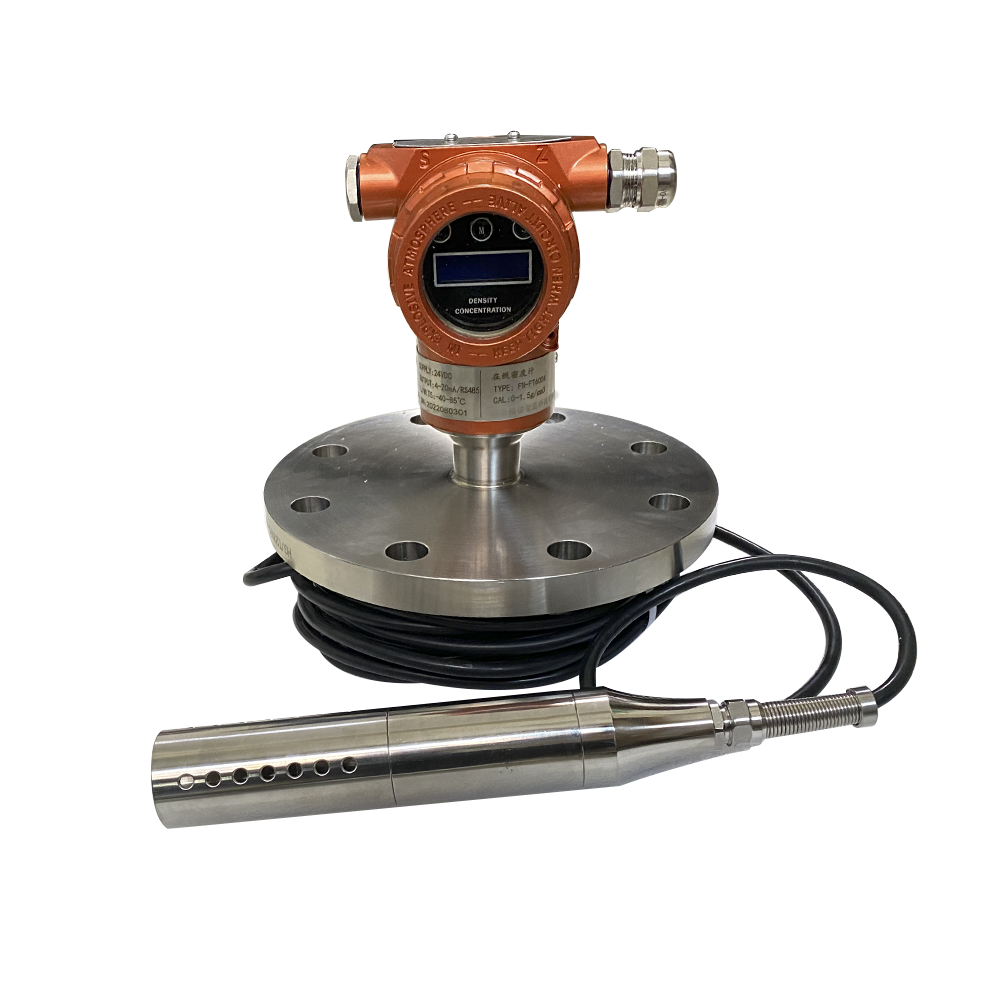
Tuning-fork density meter. A vibrating fork immersed in the stream senses density from its resonant frequency. In a refinery it is compact, fast, and — in certified housings — rated for hazardous areas. It suits clean-to-lightly-fouling hydrocarbon streams and small-to-mid lines. Our tuning-fork density meter piece covers the wet-end and range details. For petrochemical density monitoring on products and intermediates, it is usually the first call.
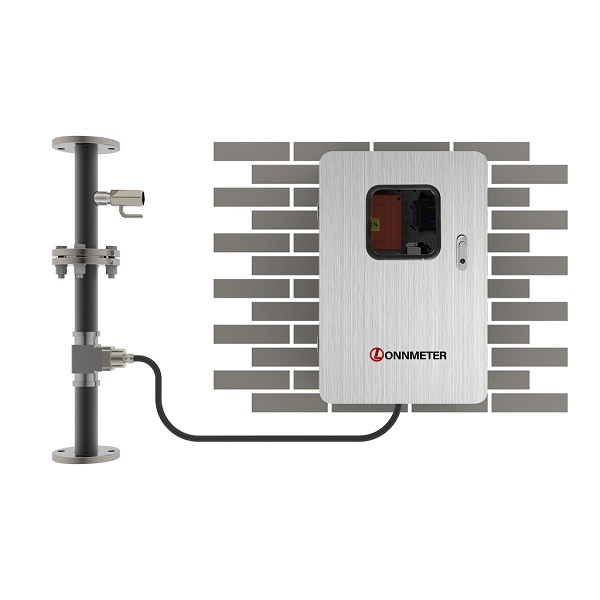
Clamp-on ultrasonic. A clamp-on ultrasonic density meter couples transducers to the outside of the pipe and sends sound across the flow; density follows from the acoustic path. No penetration, no process opening, no confined-space entry to fit it. On large crude or product lines where cutting in is expensive or the area is tightly zoned, that non-intrusive nature is the whole argument. The trade is discipline: clean pipe wall, good coupling, and you must keep scale and gas off the inner surface.
Coriolis. A Coriolis meter infers density from tube vibration while it measures mass flow — so on a blend or meter run you get both from one device. Where density is the only goal it costs more than a fork, but where you are already buying the flow duty it is efficient. The Coriolis density meter comparison walks the trade against tuning-fork and ultrasonic.
Nuclear (gamma) density meter. A sealed source and detector straddle the pipe; density comes from attenuation. It is non-contact, tolerates the worst fouling and highest pressure, and needs no process opening. It also needs a radiological license, shielding, and a safety program — a regulatory load, not a technical one. For coke-laden or heavily scaling lines where nothing else survives, it earns its place; for clean product it is overkill.
How inline and lab differ on cost — the honest version
The cost question in petrochemical density monitoring has two answers depending on what you count.
Capital vs operating
A lab U-tube is cheap to buy and expensive to run: technician time, hazardous-area exposure, bottle handling, and the cost of decisions made on stale data. An inline transmitter is dearer up front and nearly free to run — it sits there and reports. Over a year of frequent sampling on a live stream, the inline side usually wins on total cost, even before you price the safety upside.
Where lab still wins
For grade release, dispute resolution, and any number that has to stand up in a commercial argument, the traceable bench reading is the arbiter. Inline does not replace it; it front-runs it. The plant that does best runs inline for control and lab for proof.
Picking the method for the stream
A short framework for petrochemical density monitoring, not a brochure:
- Clean product or intermediate, small-to-mid line, hazardous area → tuning-fork, in a certified housing. Fast, compact, low upkeep.
- Large line, no appetite for a process opening, or tightly zoned → clamp-on ultrasonic. Accept the coupling discipline.
- Blend or meter run where you also need mass flow → Coriolis. One device, two signals.
- Heavy, scaling, or coke-laden fluid → nuclear, if the radiological program is in place; otherwise a fork you can pull and clean on a planned cycle.
- Grade release and disputes → keep the lab U-tube as the reference.
The density meter selection guide expands this into a full decision table, and the inline measurement methods guide compares the technologies side by side. The inline vs Coriolis comparison is useful where flow and density are both on the table.
Installation and hazardous-area notes that actually matter
Petrochemical density monitoring lives or dies on the mounting, the same as any inline install — plus a few refinery-specific items.
- Zone and certification. Match the transmitter’s hazardous-area rating (intrinsic safety or flameproof, to the relevant ATEX/IECEx zone) to the location. The certificate is part of the spec, not paperwork.
- Keep the pipe full and representative. A density cell in a line that runs with vapor at the top reads air part of the day. Vertical upward runs and a straight length downstream of pumps and elbows stay the rule.
- Temperature at the cell. Density is temperature-coupled. Read temperature at the density point, not somewhere else on the unit, or your correction will carry someone else’s gradient.
- Plan the pull. For fouling streams, choose a device and location you can isolate and clean on a turnaround, not one that strands you until the next one.
Our non-nuclear density measurement in the chemical industry article covers wet-end materials and the non-nuclear choices for corrosive and hazardous streams more broadly.
What we build, and an honest boundary
We design, develop, and manufacture inline density transmitters as part of an integrated measurement line — so the fork, the ultrasonic coupling, and the system behind them come from one engineering team rather than three vendors. That matters in a refinery because the install, the wet-end material, and the signal all have to agree under heat, pressure, and zone rating.
One boundary to state plainly: this article covers refining and petrochemical process streams — crude, products, intermediates, polymer slurries. Cryogenic LNG density measurement is a different problem (low temperature, different materials, different certification) and sits outside this piece. And the hazardous-area certificates above describe what to check, not a claim that any specific model holds any specific rating — confirm the certificate on the unit you buy.
The short version
Petrochemical density monitoring is less a measurement upgrade than a loop closure: the number you trade and blend on should be the number the fluid actually had, not the one a bottle remembered from an hour ago. Use the lab for proof, use an inline transmitter for control, and pick the inline technology by the fluid and the pipe — fork for clean hydrocarbon, ultrasonic for no-opening, Coriolis where flow travels with it, nuclear only where nothing else survives. Close that loop and the custody transfer, the blend, and the balance all start from the same true density.
Frequently asked questions
Why measure density online in a refinery?
Density drives custody transfer, blend control, and process mass balance. An inline signal keeps those numbers current instead of relying on a sample drawn an hour earlier, when the parcel or blend had already moved.
Is an inline density meter safe in explosive atmospheres?
Yes, when the transmitter carries the hazardous-area rating for the zone — intrinsic safety or flameproof, to the relevant ATEX or IECEx classification. The certificate is part of the spec, and it also removes people from sample-point draws in dangerous areas.
Which inline method fits crude oil custody transfer?
For a meter run where you also need mass flow, a Coriolis meter gives density and flow from one device. On a large line with no appetite for a process opening, clamp-on ultrasonic is the non-intrusive option. A lab U-tube remains the traceable reference for disputes.
Can a Coriolis meter replace lab density checks?
For live control, yes. For grade release and commercial disputes, keep the traceable lab U-tube as the arbiter. Inline front-runs the lab; it does not replace it for proof.
How does inline compare to laboratory density measurement in cost?
A lab U-tube is cheap to buy but expensive to run — technician time, hazardous-area exposure, and decisions on stale data. An inline transmitter costs more up front and almost nothing to run, so over a year of frequent sampling it usually wins on total cost, before counting the safety upside.
What density range do petrochemical streams cover?
Light hydrocarbons sit near 0.6 g/cm³; refined products run roughly 0.7–0.9 g/cm³; heavy ends, asphalt, and residues exceed 1.0 g/cm³. The wide span is why method and wet-end choice track the specific stream.
LONNMETER GROUP designs, develops, and manufactures inline density and concentration measurement instruments for industrial process applications. Questions about a specific stream or zone? Talk to our engineering team.